Restaurant Email vs SMS Marketing: Which Drives More Orders in 2026?
If you’ve been wondering whether to focus on email or text marketing for your restaurant, you’re asking the right question — just not quite the right way.
Email and SMS aren’t competing channels. They’re different tools that work best at different moments. Understanding when to use each one, and how to run them together, is what separates restaurants that see real repeat revenue from marketing from those that don’t.
Here’s how to think about it.
- Email builds the relationship.
- SMS drives immediate action.
- The best restaurant marketing strategy uses both together.
- Email works best for retention and lifecycle campaigns.
- SMS works best for urgency, same-day promos, and limited-time offers.
- Together, they help turn one-time diners into repeat orders.
Email vs. SMS: What’s the Real Difference?
Both channels let you reach guests directly. But they behave very differently once a message is sent.
Email is a lifecycle channel. It’s best for building a relationship over time — welcoming a new guest, re-engaging someone who hasn’t ordered in 60 days, promoting an event, or telling your regulars about a menu change. Open rates for restaurant email average around 20–30%, and while that may sound low, the guests who do open are typically your most engaged customers. Email gives you space to say more, and it works in the background without much ongoing effort.
SMS is an immediacy channel. It’s designed for right now. Texts are read within 3 minutes 90% of the time, and they drive roughly 5x higher engagement than email alone. That makes SMS exceptionally powerful for filling a slow Tuesday lunch or pushing a limited-time offer before the dinner rush, but less suited for the kind of relationship-building that keeps guests coming back over months.
The key distinction: email builds loyalty over time; SMS creates action right now.

Email and text marketing is part of our 2026 Spring Product Launch. Check out all the new products we’ve released in our What’s New blog.
Performance Benchmarks: What the Data Shows
When Email Works Best for Restaurants
Email earns its place in your marketing through consistency and reach. It’s the channel that keeps working even when you’re not thinking about it.
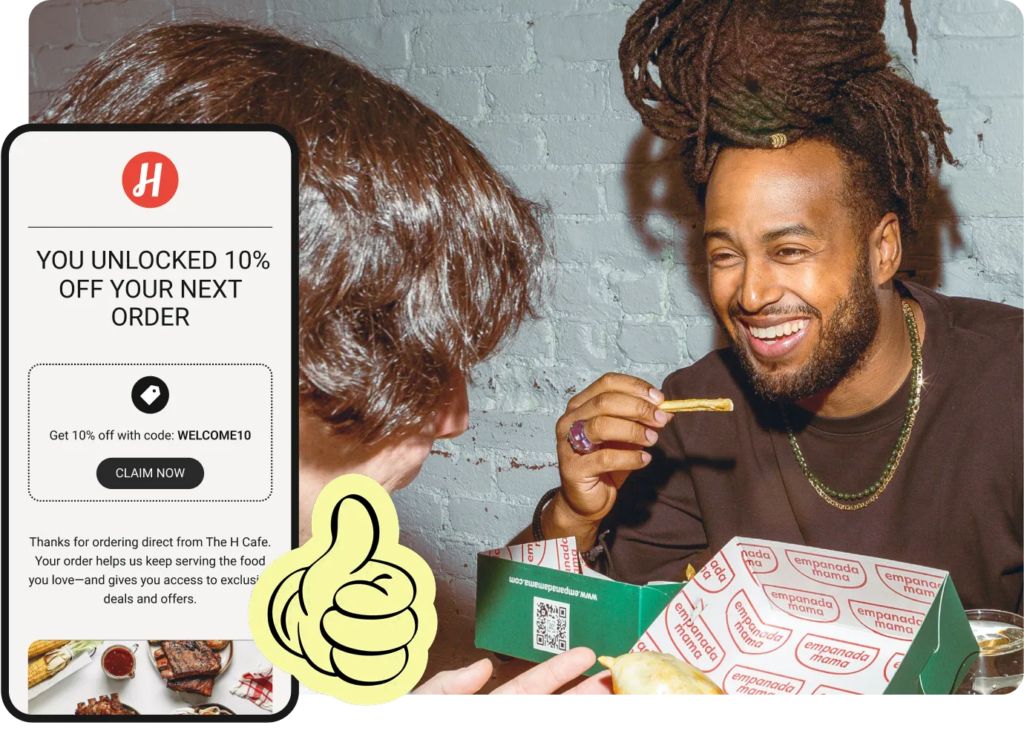
Automated campaigns are the foundation. A welcome email that goes out after every first order, a win-back message that reaches guests who haven’t ordered in 30 or 60 days, a VIP reward for your most loyal customers — these run in the background without any ongoing effort and keep your restaurant top of mind across the full customer lifecycle.
Promotions and announcements also live naturally in email. Launching a new menu? Reopening the patio? Hosting a private event? Email gives you the space to tell the story and drive action over a longer window than a single text.
Retention over time is where email really separates itself. Targeted, segmented campaigns, sent to the right audience based on real ordering behavior, drive 77% of total email revenue. The restaurants still sending generic blasts to their entire list are leaving most of that on the table.

One number worth knowing from ChowNow platform data: Restaurants with a 1,000-diner email list generated about $10K a year from automated emails alone, with even more upside through SMS and audience growth.
When SMS Works Best for Restaurants
SMS closes the gap between message and order faster than any other channel.
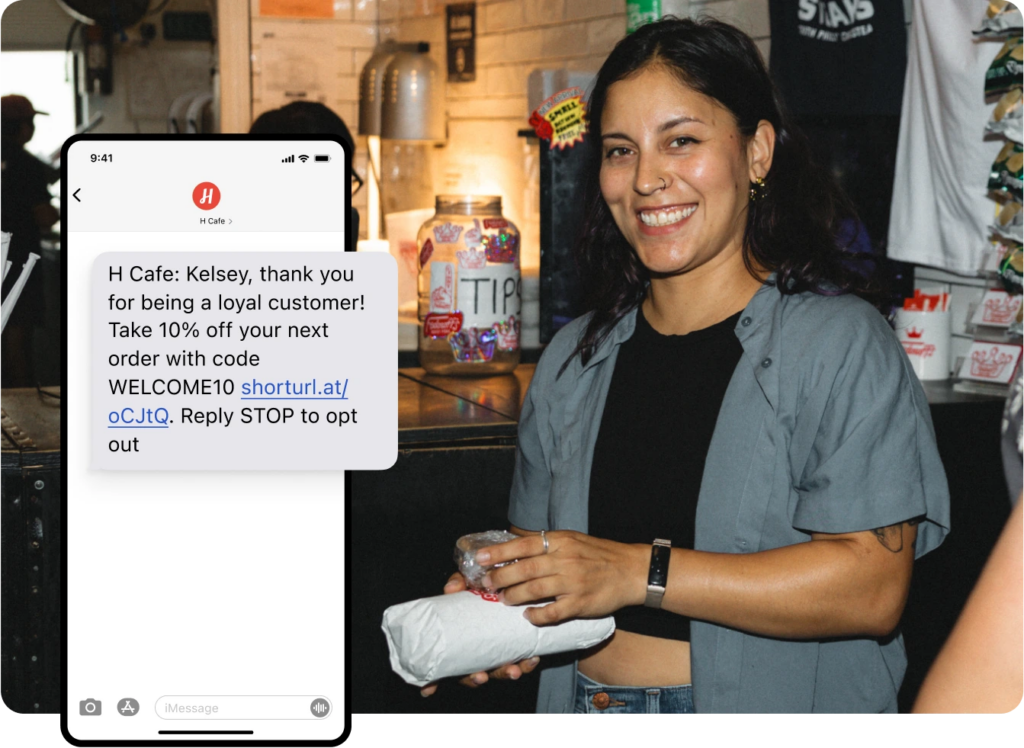
Same-day demand is the most obvious use case. A text that goes out at 11am about a lunch special hits guests at exactly the right moment, when they’re already thinking about where to eat. By the time an email might be opened, the lunch rush is over.
Slow period recovery is where SMS earns its keep most clearly. When a Tuesday is tracking slower than expected, a quick text to your lapsed or repeat guest segments can drive orders within the hour. No other channel moves that fast.
Limited-time offers, like a flash promotion, a weekend special, or a last-minute event need to land immediately or they miss the window. SMS is the only channel that reliably gets there in time.
One important note: SMS works because it feels direct. That means restraint matters. Guests who opted in to hear from you will stay engaged if messages are relevant and well-timed. Overusing the channel erodes that trust quickly.
Want to learn more about SMS marketing? Read our blog here.
The Best Strategy: Use Email and SMS Together
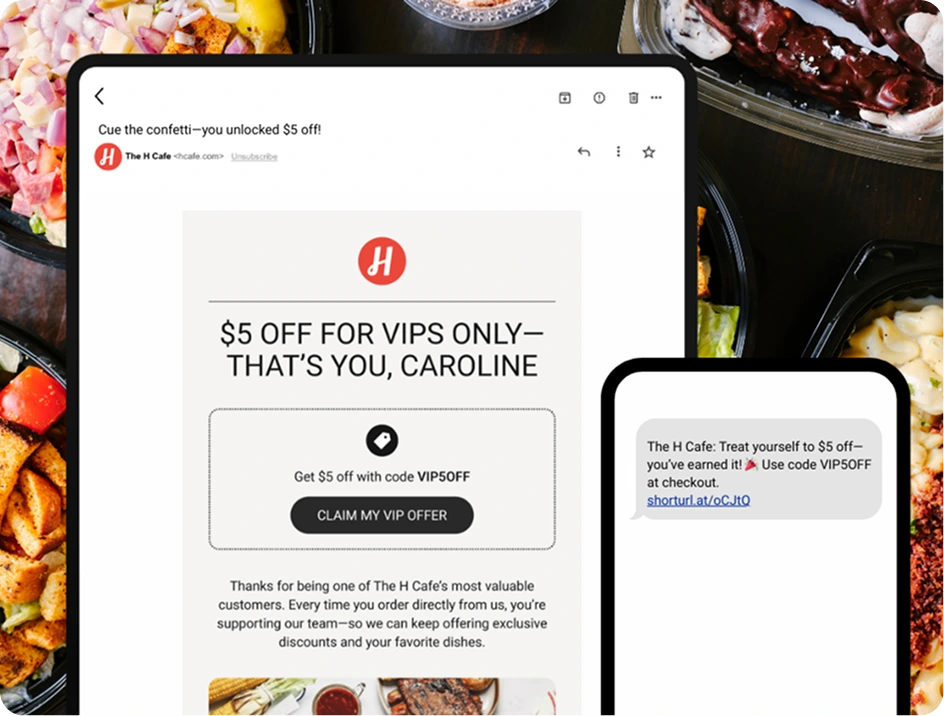
Running email and SMS as separate channels means you’re only using each one at half its potential. The real lift comes when they work in sequence.
Here’s what that looks like in practice:
Example Campaign Flow
A guest hasn’t ordered in 30 days. They’re in your Win Back segment.
- Day 1 — SMS: “Hey, it’s been a while. Come back this week and get 10% off your next order. Order here: [link]” (Immediate, urgent, direct.)
- Day 2 — Email: A slightly longer message that reinforces the offer, shows what’s new on the menu, and reminds them why they liked you in the first place. (Adds context, builds the relationship.)
- Day 7 — SMS (if no order): A short final reminder before the offer expires. (Creates urgency for guests who saw the email but didn’t act.)
SMS creates the impulse. Email builds the relationship. Together, they close more of the gap between a guest who drifted away and one who comes back regularly.
The same logic applies to new guests. A welcome email sets the tone; a follow-up SMS a few days later with a first-order incentive drives the second visit. Each channel reinforces what the other started.
Where Most Restaurants Lose Revenue
The most common mistakes aren’t about using the wrong channel — they’re about not using enough of what’s already available.
Relying on one channel alone cuts your reach in half. Guests who don’t open email still read texts. Guests who find SMS too immediate still engage with email. Covering both means you’re meeting every guest where they are.
No follow-up after the first order is the single biggest missed opportunity in restaurant marketing. Acquiring a new customer is expensive. Losing them after one order is even more expensive. A simple automated sequence, welcome email, SMS check-in, win-back if they go quiet, turns a one-time buyer into a regular without any manual work.
Sending to the full list every time is another major revenue leak. Guests who ordered yesterday don’t need a win-back message. New guests don’t need a VIP reward yet. Sending the right message to the right segment — Welcome, Win Back, VIP — is what makes campaigns feel personal rather than like spam, and it’s what drives 77% of email revenue for the restaurants doing it well.
Marketing only to online customers leaves a significant portion of your audience unreached. If you’re only marketing to guests who ordered through your restaurant website or branded mobile app, you’re missing every dine-in guest, every walk-in, every phone order. Uploading your in-store guest list and combining it with your online data gives you a complete picture of your customer base, and restaurants that do this see up to 3x growth in their marketable audience.
Restaurants with a branded app see up to 2x more direct orders and catering is a natural extension of that direct relationship.
How to Set This Up Without Extra Work
The reason most independent restaurants aren’t running email and SMS together isn’t lack of interest, it’s that the tools have historically been disconnected, complicated, or designed for marketers, not operators.
ChowNow’s Marketing Suite is built differently. Email and SMS live in the same dashboard, powered by the same ordering data, with pre-built automations that handle the sequencing for you.
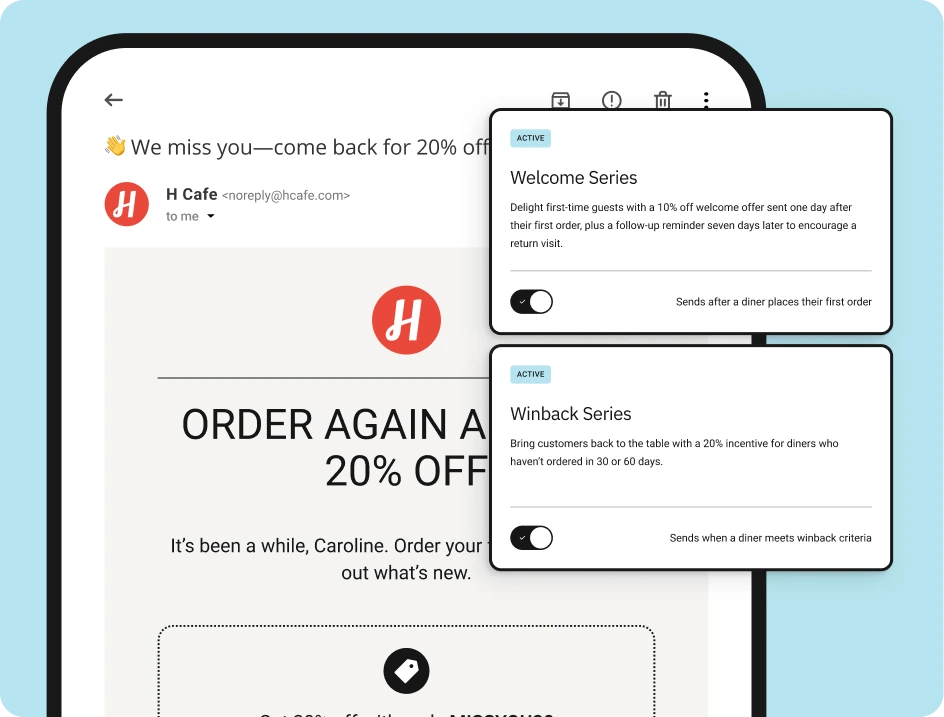
Here’s what that means in practice:
- Automated campaigns are ready to activate. Welcome, Win Back, VIP, and Seasonal campaigns are pre-built. You turn them on; they run.
- Segmentation happens automatically. New, Repeat, VIP, and Lapsed audiences are generated from real order behavior — no manual list-building required.
- On-demand campaigns take minutes, not hours. When you want to push a same-day promotion or announce something new, the editor is built into the same dashboard you’re already using.
- Reporting is tied to real revenue. You see sends, opens, clicks, and the orders each campaign actually drove.
The result is a marketing engine that works in the background on the slower days and scales up when you need it, without adding more to your plate.
Want to learn more? Check out our guide built for restaurant operators comparing online ordering tools and looking for a clearer path to growing direct, repeat orders.
Frequently Asked Questions
Is email or SMS better for restaurant marketing?
Neither is universally better — they serve different purposes. SMS drives immediate action and is best for same-day promotions and time-sensitive offers. Email builds relationships over time and is best for lifecycle campaigns, retention, and announcements. The most effective restaurant marketing uses both channels together in sequence.
How often should restaurants send SMS marketing messages?
Less is more with SMS. Most restaurants see strong engagement with 2–4 texts per month, focused on genuinely relevant moments — a slow period promo, a limited-time offer, a win-back message for lapsed guests. Sending too frequently reduces opt-in rates and erodes the directness that makes SMS effective.
Do restaurant email campaigns actually drive orders?
Yes. ChowNow platform data shows restaurants with a 1,000-diner email list generating approximately $10K in annual attributed revenue from automated email campaigns alone. Targeted, segmented campaigns drive 77% of total email revenue — significantly outperforming generic list blasts.
What’s the difference between automated and on-demand campaigns?
Automated campaigns run continuously based on guest behavior — a welcome email after a first order, a win-back message after 30 days of inactivity. On-demand campaigns are one-time sends you create and schedule yourself for specific moments like promotions, events, or new menu launches. Both types are included in ChowNow’s Marketing Suite.
Do I need separate tools for email and SMS marketing?
Not with ChowNow. Email and SMS marketing are built into the same platform as your ordering system, so your campaigns are automatically powered by real guest data — no integrations, no exporting lists, no switching between tools.