How to Start a Catering Business at Your Restaurant (Step by Step)
Good news: you already have everything you need to start a catering business. The kitchen. The food. The team. And if diners keep asking, you already have the demand too. The one piece left to add is a system. And that is exactly what this guide is.
This is a guide for the restaurant that is already operating and ready to turn those “hey, do you cater?” requests into a real, repeatable revenue stream. Catering is one of the highest-margin opportunities available to independent restaurants, with average catering orders 9 to 10x larger than typical takeout. The potential is already sitting in your kitchen. It just needs a process to match.
- Starting a catering business doesn’t require building something new. It’s an extension of the team and kitchen you already have.
- Picking one clear use case first keeps your launch focused and your team confident.
- A package-based menu reduces back-and-forth and makes ordering simple for diners.
- Lead times, order minimums, and delivery windows protect your kitchen before the first order comes in.
- Getting catering orders online is the single biggest operational unlock for capturing more revenue with less effort.
Catering can add high-margin revenue without a new kitchen or new staff
The opportunity here is real. The catering industry is projected to surpass $124 billion by 2032, and the majority of that demand comes from everyday orders: office lunches for 20, birthday trays for 30, team meals ahead of the afternoon meeting, happening right in your neighborhood.
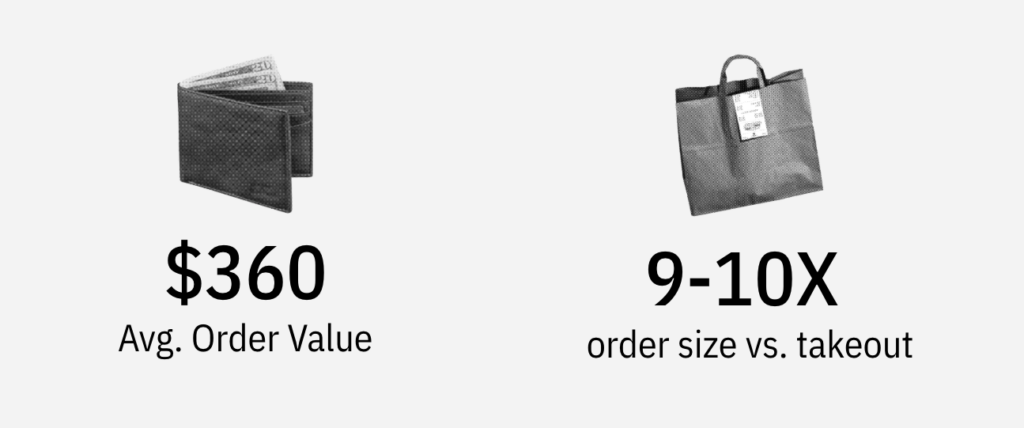
Here’s what makes catering especially worth it for independent restaurants: the average catering order is significantly larger than a typical takeout ticket. Data from our restaurant partners already offering catering through their direct ordering channel puts the average catering order value around $360, which means you’re using the staff and kitchen you already have, just more efficiently. More revenue per labor hour. Higher margin per order. And because catering is scheduled in advance, it brings something takeout rarely can: predictability.
That’s midweek revenue you can plan around. Staff schedules that make sense. Prep that flows instead of piles up.
The restaurants that make catering work best are the ones who build the system before they start promoting it. A solid foundation means you can say yes confidently and execute consistently every time.
How to start a catering business in 5 steps
Step 1: Choose Your Catering Lane

When you’re figuring out how to start a catering business, the biggest mistake is trying to offer everything at once. Start by picking one use case and owning it. Office lunches. Boxed meals. Party trays. Family-style spreads for weekend gatherings. Doing one thing really well is the fastest path to a catering operation that runs smoothly and grows steadily.
Decide upfront whether you’re offering pickup, delivery, or both. Then define your “yes list” so your team knows exactly what they can execute with confidence. This gives everyone clarity, reduces mistakes, and means fewer scrambles when a big order lands.
Starting focused also makes marketing easier. “We do office lunches for teams of 10 to 30” is a much cleaner message to get out into the world, and you can always expand from there.
Step 2: Build a package-based menu
A strong catering menu is a curated selection of your best sellers, packaged in a way that makes ordering easy and fulfillment even easier. So, what should a restaurant catering menu include? Four to six items your kitchen already makes well and that hold up during transport or a buffet setup: a protein, a starch, a vegetable side, and one or two desserts is a solid starting point. Skip anything that needs to be plated or finished a la minute.
Start with dishes that travel well and hold up over time. Think proteins like roasted chicken, brisket, or grilled salmon. Build around formats that are easy to serve in a group setting: grain bowls, taco bars, sandwich platters, or family-style pastas. Pair those with crowd-friendly sides like roasted vegetables, salads, and bread that hold their texture after transport.
‘Team Lunch For 10’ books faster than ‘Large Tray Option B.’
Build 3 to 5 packages named by outcome rather than portion code. Use “serves X people” or per-person pricing so diners can order without doing the math themselves, and your team spends less time clarifying over the phone.
The goal is a menu a diner can navigate entirely on their own from a dedicated catering page on your website or app. Built-in serving size guidance and dietary labels go a long way here. They help diners choose the right portions and flag preferences upfront, so your team spends more time on prep and less time on back-and-forth. For more menu-building detail, see our full catering software comparison, which breaks down which platforms make package-based menus easiest to set up.
Step 3: Set guardrails that protect your kitchen
Before you take your first catering order, lock in your operational rules. These are the decisions that let your kitchen run smoothly and your team stay in control, and they’re the part of starting a catering business that most restaurants skip too quickly
Setting a min and max order amount early is especially useful. A minimum makes sure every order justifies the prep time. A maximum keeps you from taking on more than your kitchen can handle in a single shift, which is one of the fastest ways to protect food quality and team morale as catering volume grows.
The gratuity and fee setting is worth configuring before your first order goes live too. It’s an easy way to offset delivery and labor costs without manually adjusting your menu pricing, and diners see it clearly at checkout so there are no surprises.
For large orders specifically, adding prep instructions to each menu item is one of the most practical things you can do for your kitchen. Clear notes on packaging, portioning, and timing give your team a shared reference point and reduce the chance of miscommunication mid-service. The more information your kitchen has before a large order starts, the smoother execution becomes from the first prep step to final drop-off.
Step 4: Get catering orders online
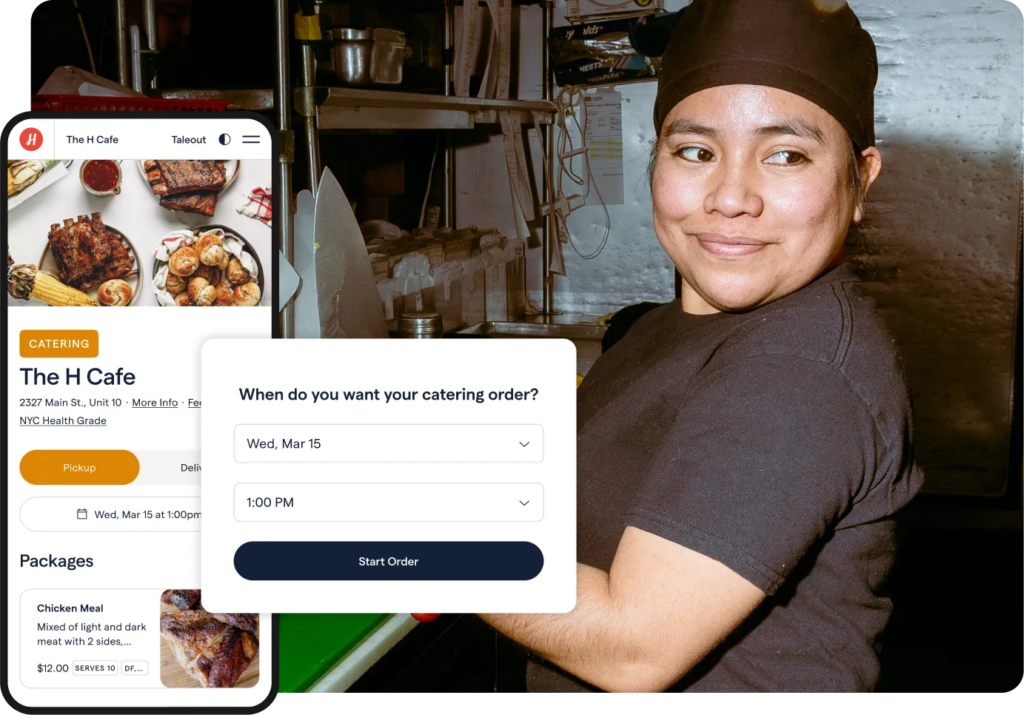
A dedicated catering page with direct online ordering is the single biggest operational unlock for your catering business, and it’s how most restaurants add online catering ordering without taking on a second system to manage. It turns catering from a manual, phone-heavy process into something diners can complete entirely on their own, at any time of day.
Standard catering orders should be fully self-serve. When the ordering experience is frictionless, more diners follow through. For larger or event-based requests, a custom inquiry form lets you collect event details upfront so nothing falls through the cracks. And when orders come in through a direct channel, you own the customer data: the full name, email, and order history that becomes the foundation of every repeat catering relationship you build.
If you’re comparing restaurant catering software options, the ones worth using sync directly to your POS so catering orders show up alongside your regular tickets instead of living in a separate inbox. With ChowNow Catering, catering orders flow into the same dashboard as your regular takeout and sync to your POS through 30+ integrations. Your team manages everything from one place with zero double entry and no extra tablets.
For restaurants offering delivery, Flex Delivery supports advance scheduling up to 30 days out, which is ideal for catering drop-offs that need to land at a precise time.

See how ChowNow Catering handles this in one dashboard. Book a demo here.
Step 5: Price to Protect Your Margins

Catering pricing should cover food cost, packaging, a labor bump for prep, and delivery, with margin built on top. A clear pricing formula keeps your catering business profitable rather than just busy.
When diners order directly through your own catering page, you protect significantly more of that margin. The difference adds up fast on every order:
On a $360 average order, that gap between direct and marketplace is over $36 per order going straight back to your restaurant.
The fee difference is significant, but the case for going direct goes beyond cost. When catering orders come through a marketplace, the platform owns the customer relationship. You fulfill the order, but the diner data stays with them. Going direct means you keep the customer name, email, and order history, which is what lets you follow up, build loyalty, and turn a one-time catering client into a repeat one. You also control how your brand shows up in the ordering experience, rather than being listed side by side with every other restaurant in your area.
Add a delivery minimum and a rush fee to your pricing structure from the start. Both protect your kitchen from orders that create more work than they’re worth.
How to promote catering once your ordering system is live

With the foundation in place, catering practically markets itself. Your existing diner base is the warmest audience you have, and a well-timed message to people who already love your food is one of the highest-converting ways to announce that catering is available.
Here are a few of the most effective channels to promote catering once you’re ready:
- Your website and app. A dedicated catering page on your restaurant website or branded mobile app puts catering front and center for every visitor already interested in ordering from you. Restaurants with a branded app see up to 2x more direct orders, and catering is a natural extension of that direct relationship.
- Your loyalty program. Your most loyal diners are the first people who should know catering is available. They already trust you and they already order regularly. If you run a rewards program, catering is a natural upsell for diners who are already engaged with your brand.
- Search and discovery. Make sure catering shows up where diners are already searching. Listing your restaurant across top discovery sites like Google, Yelp, and Apple Maps means you capture demand that would otherwise go to a marketplace. A catering-specific menu item or listing in those channels goes a long way toward appearing when someone nearby searches for “catering near me.”
- In-restaurant promotion. Your current diners are your best catering leads. Table cards, receipts, and staff mentions at checkout are low-effort ways to let regulars know catering is an option the next time they’re planning an event. A QR code on a table tent linking straight to your catering page removes even that small bit of friction.
Every catering order you fulfill through a direct channel is also a relationship you can build on. That customer data is what turns a one-time office lunch into a standing weekly order. That’s how catering stops being a nice-to-have and becomes a predictable, plannable revenue stream.
For a deeper look at catering-specific promotion strategies, check out our guide on 9 catering marketing ideas to grow restaurant sales. And if you want to see the full economics of adding this revenue channel, our guide on restaurant catering as a high-margin revenue channel breaks down the numbers in more detail.
And if you want the full launch plan in one place, download the Catering Playbook. This is built for independent restaurants ready to make catering a real revenue line.
Ready to Start Taking Catering Orders?
You’re closer than you think. The kitchen is ready. The demand is there. The step between where you are now and a catering operation that runs reliably is a system that supports it.
ChowNow Catering gives independent restaurants a digital, owner-controlled way to capture and manage high-value catering orders directly, with full customer data ownership, POS integrations, and operations built in from day one.
Book a demo to see how it works.
Frequently asked questions about starting a catering business
How do I start a catering business from my restaurant?
Starting a catering business at your existing restaurant is simpler than most operators expect. Begin by choosing one catering use case, building a package-based menu from your best sellers, and setting operational guardrails like lead times and order minimums. Then get catering orders online through a dedicated page so diners can order without calling. ChowNow Catering lets you launch within your existing online ordering setup with no separate system required.
What should a restaurant catering menu include?
Four to six items your kitchen already makes well and that hold up during transport or a buffet setup: a protein, a starch, a vegetable side, and one or two desserts. Skip anything that needs to be plated or finished a la minute, and organize the menu into 3 to 5 named packages rather than a long a la carte list.
How do restaurants manage large catering orders?
By setting minimums, lead times, and prep checklists ahead of time, and by routing every order through one system instead of juggling phone calls, texts, and email. Restaurants that take catering orders online get a written record of quantities, allergies, and delivery details automatically, which cuts down on mistakes as order size grows.
What catering platform is best for an independent restaurant?
The best fit is one that syncs to your existing POS, lets you keep your customer data, and charges a flat, predictable rate instead of a per-order marketplace commission. Look for a platform that keeps catering orders in the same dashboard as your regular takeout, rather than a separate tool your team has to check independently.
Can catering software integrate with my restaurant’s ordering system?
Yes. Most restaurant catering software is built to sync with your existing POS, so catering orders show up alongside your regular tickets instead of living in a separate inbox. Confirm POS compatibility before you commit to a platform. ChowNow Catering syncs through 30+ POS integrations.
What’s the typical setup time and cost for restaurant catering software?
Most catering platforms for restaurants can be set up in a few days once your menu and pricing are ready, since they build on ordering tools you likely already use. Cost varies by provider and is often bundled into your existing plan rather than billed as a separate line item.
What’s the ROI of adding online catering ordering to my restaurant?
Catering orders average around $360, well above a typical takeout ticket, and carry higher margins than full-service dining since the orders are larger and scheduled in advance. Even a handful of catering orders a week can add meaningful, predictable revenue without expanding your dining room or hiring additional staff.
How can my restaurant grow its catering business?
Start with your existing diners, follow up after every order to ask about repeat bookings, and expand into local business outreach once your process is running smoothly. Restaurants that keep their own customer data can market directly to past catering clients instead of starting from zero each time.
How do restaurants handle corporate catering orders online?
Through a dedicated catering page with serving-size guidance, dietary labels, and clear lead times, so a corporate diner can place an order for a group without a phone call. Orders route straight into the restaurant’s existing dashboard and sync to the POS, so nothing gets missed during a busy prep window.
What’s the easiest way to add catering to my restaurant business?
Start with drop-off catering using your current menu, kitchen, and staff, and take orders through a dedicated page on your own website. It’s the lowest-effort entry point and doesn’t require new equipment, new hires, or a new ordering system.
What is the best way to start catering services without disrupting my kitchen?
The key is building guardrails before you take your first order. Set lead times, delivery windows, and order minimums that give your kitchen the predictability it needs. Catering orders scheduled in advance are far easier to manage than last-minute requests, and a self-serve ordering page eliminates the phone chaos entirely.
How much does it cost to start a catering business at a restaurant?
The startup cost is lower than most operators expect. You’re working with the kitchen, staff, and equipment you already have. The main investments are packaging, any additional prep labor, and the platform you use to take orders. Going direct rather than through a marketplace also protects your margins significantly: direct catering fees run around 5% versus up to 15% on third-party platforms.
What should I charge for catering at my restaurant?
Build your catering price by stacking food cost, packaging, a labor bump for prep, and delivery, then add your target margin on top. Using per-person or “serves X” pricing makes it easy for diners to order and easy for your kitchen to plan. Add a delivery minimum and a rush fee for short-notice orders to protect your margins from the start.
Do I need a separate license to start catering services?
In most cases, your existing food service license covers catering prepared from your restaurant kitchen. Requirements vary by state and county, so checking with your local health department before launching is always a smart first step.
Is starting a catering business worth it for a small independent restaurant?
Yes, and the numbers back it up. The average catering order value is around $360, which means strong revenue from the team and kitchen you already have. Starting with a focused, simple setup keeps the lift manageable while the revenue opportunity is significant from day one. For more on growing revenue as an independent restaurant, read our guide on how to attract more guests to your restaurant.
How do I get catering clients as a restaurant?
Your existing diner base is your best starting point. People who already love your food are the most likely to book catering. Promote catering on your website, app, and in-restaurant touchpoints first. From there, showing up on local discovery platforms and search results for terms like “catering near me” or “office lunch catering” helps you reach new clients who are actively looking.