Restaurant Email and SMS Marketing: How Independent Operators Drive Repeat Orders
If you run an independent restaurant, you probably don’t have a marketing team. You might not even have a marketing person. What you do have is a customer list growing every time someone places an online order, and a steady, nagging sense that you should be doing something with it.
This guide covers whether email is still worth your time, how marketing automation actually works, the campaigns that drive the most repeat orders, and how SMS fits in alongside email.
Is email marketing even worth it for an independent restaurant?
Yes, and the math is harder to argue with than most operators expect. ChowNow restaurants with a 1,000-diner email list generate roughly $10,000 in annual attributed revenue from automated emails alone. That’s before SMS, before list growth, and before adding on-demand campaigns. Restaurants using marketing automation typically see a 3–5x increase in ROI per campaign compared to generic blasts.
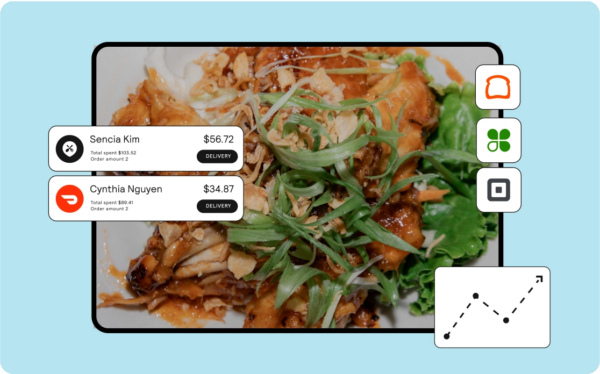
The catch: email marketing only works if it’s connected to how your customers actually order. A generic email tool that doesn’t know who ordered last week or who hasn’t been back in 60 days will send the same message to everyone, which is why most restaurants stop seeing returns after a few sends. The operators getting the strongest ROI are using platforms where email and ordering data live in the same place.
For a broader view of how restaurant marketing comes together across channels and seasons, the 2026 Restaurant Marketing Calendar maps out a full year of moments worth planning around.
What is restaurant marketing automation and how does it work?
Restaurant marketing automation is software that sends the right message to the right diner based on what they’ve ordered, when they last visited, or what they’re worth to your business, without you having to write or send each message manually. It rests on three pillars:
- Triggered campaigns run automatically when a diner does something — places a first order, goes X days without ordering. You set them up once.
- Segmentation groups your customer list by behavior (new, repeat, VIP, lapsed) so the message matches who’s receiving it.
- Multi-channel delivery combines email and SMS so each campaign reaches diners through the channel they’re most likely to engage with.
For a time-starved operator, automation isn’t a luxury feature. It’s labor replacement.
How do small restaurants do email marketing without a dedicated marketer?
The operators who pull this off without hiring help share a pattern: they use a platform with automation built in, plug it into their existing customer data, and set it up once. The three-step approach:
- Use a restaurant-specific platform. Generic email tools (Mailchimp, Constant Contact) require you to build templates and figure out segmentation from scratch. Restaurant-specific platforms come with pre-built campaigns for what restaurants actually need: welcome series, win-backs, VIP messages, seasonal promotions.
- Plug into your ordering data. If your email tool doesn’t know who ordered what or when, you’re flying blind.
- Set it once, then leave it alone. A welcome series doesn’t need rewriting every month. The point of automation is that it earns money in the background.

“Having automated email is great. With monthly marketing on autopilot, that lets me worry about other things for my business.”
— Billy Wang, Ollie’s
ChowNow’s Email & SMS Marketing was built for this operator profile. It’s plugged into your ordering data from day one, the campaigns are pre-built and pre-targeted, and it lives in the same dashboard you already use to manage online orders.
What’s the easiest way for a busy restaurant owner to start email marketing?
Start with what you already have, in this order:
- Pull your customer list from your online ordering platform. If you’re on ChowNow, this is already done — every online order builds your list automatically.
- Turn on a welcome email. First-time diners are the most likely to come back if you reach them within the first 7 days.
- Send a first promotion to your full list. Pick something simple: a slow-day special, a new menu item, a holiday offer. The goal is getting started, not perfection.
- Turn on automated campaigns. Once you’ve sent one promotion, switch on the always-on campaigns — welcome, win-back, VIP— and let them run.
Most operators get through this in a couple of hours, not a couple of weeks.
How can a small restaurant build a customer email list?
Three sources give you the most diners in the shortest time:
Online order capture. Every online order is a marketing contact. This is where independent restaurants on direct-ordering platforms have a structural advantage over those routing everything through third-party marketplaces, where the customer relationship sits with the marketplace, not you.
QR Code Ordering at the table. Dine-in guests have historically been invisible to restaurant marketers. QR Code Ordering closes that gap by capturing diner contact information at the moment of order.
In-store sign-up. A counter card or check-in field at the host stand still works. Slower than the first two, but compounds over time.
For operators who want to turn first-time diners into regulars, the Repeat Customer Kit walks through the full retention playbook.

Want more like this in your inbox? Subscribe to ChowNow Feed.
How can restaurants segment customers for better email marketing?
Four segments do most of the work:
- New diners. Just placed their first order. Most likely to come back if you reach them within 7 days.
- Repeat. Order steadily, two to four times a month. Don’t over-message them, but keep them on every promotion.
- VIPs. Your top 10–20% by frequency or spend. Worth their own messages and the occasional “thank you” that doesn’t ask for an order.
- Lapsed. Used to order, hasn’t in X number of days. The win-back segment, and one of the highest-ROI campaigns you can run.
Segmentation matters because targeted, segmented campaigns drive 77% of total email revenue, yet most restaurants still send generic blasts to their entire list. The revenue is sitting in the difference between “everyone gets the same email” and “the right diner gets the right message.
ChowNow’s Email & SMS Marketing handles segmentation automatically. Audiences are auto-generated from ordering activity (New, Repeat, VIP, Lapsed) so you don’t build lists manually or guess who should get what.
The Marketing Suite eBook walks through what smart segmentation looks like in practice.
What are the best automated email campaigns to set up for a restaurant?
Three campaigns earn their keep for almost every independent restaurant:
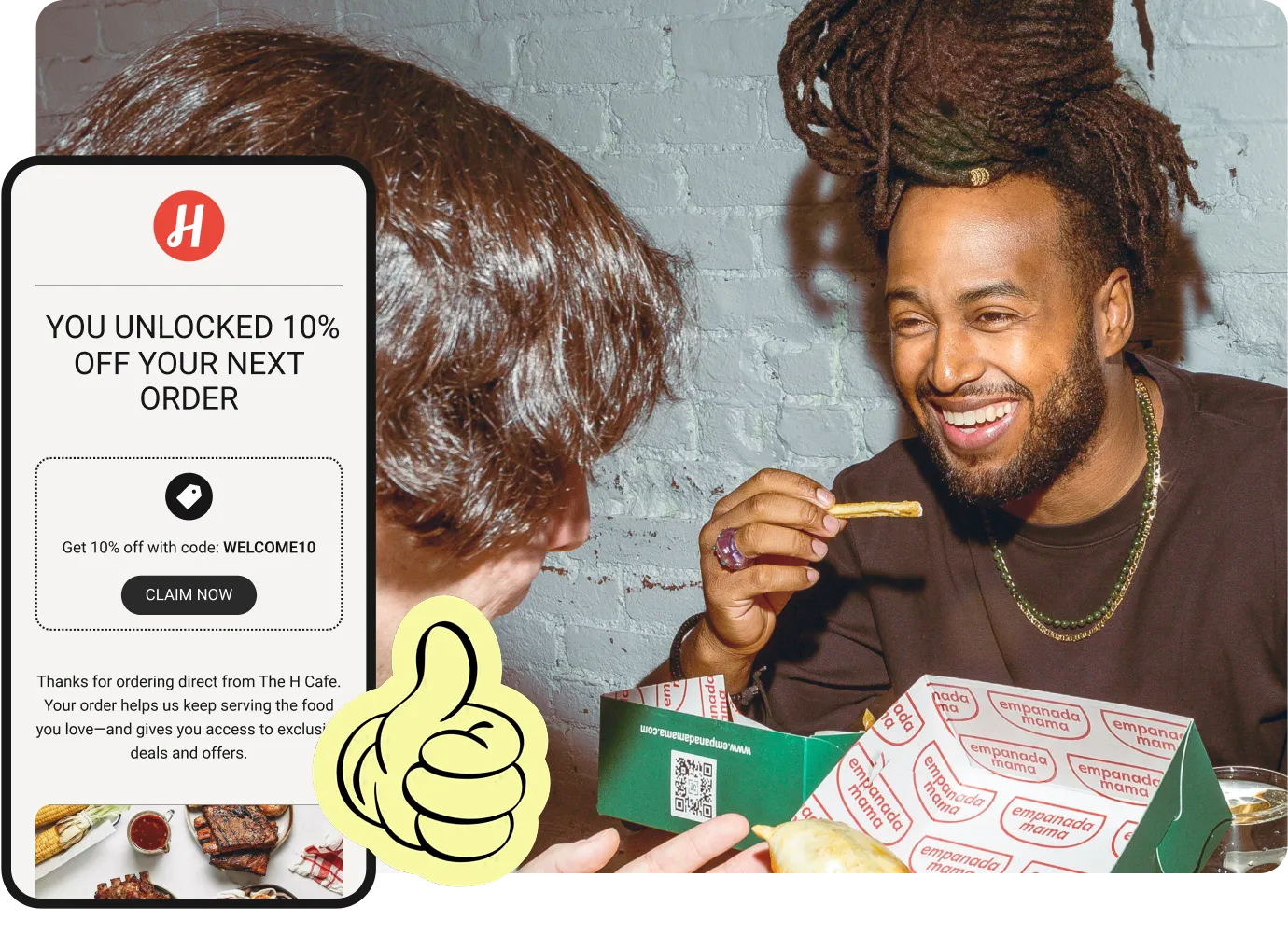
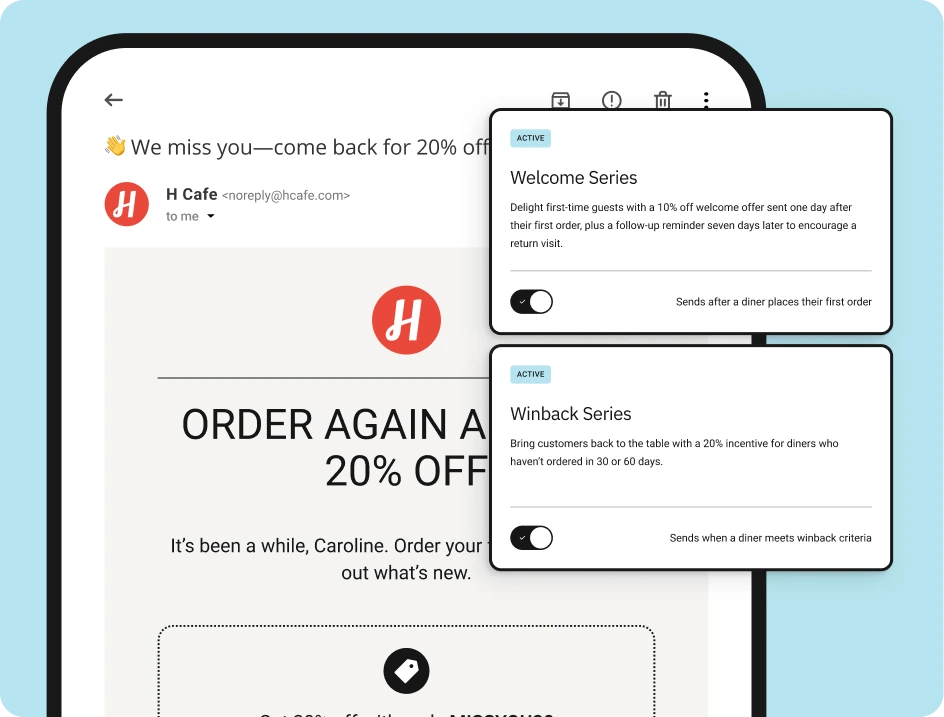
- Welcome. Triggers when a diner places their first order. Highest-leverage campaign you can turn on, since new diners are most likely to convert into regulars within their first 7 days.
- Win-back. Triggers when a regular hasn’t ordered in X number of days. Re-engages them before they’re permanently lost.
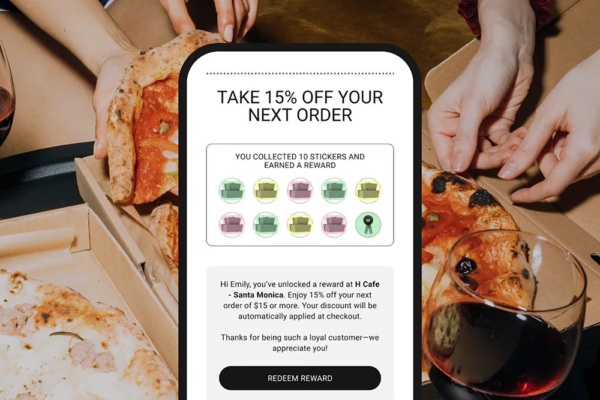
- VIP. Triggers when a diner hits a Rewards threshold and gives them a reason to redeem it (which usually means another order).
- Seasonal moments. Create specialized event or diner experiences rather than standard service.
For campaign-level inspiration on what to actually say, 17 Restaurant Promotion Ideas covers the offers, hooks, and seasonal tie-ins that consistently drive opens.
How do automated email campaigns work for restaurants?
The flow is simpler than it sounds: trigger, segment, send, measure. A trigger is the event that fires the campaign (a first order, or X days of inactivity). The segment defines who qualifies. The send is the message itself, drawn from a pre-built template. The measure is the part most generic email tools skip: campaigns should report on attributed orders and revenue, not just opens and clicks, so you know what’s actually driving sales. A platform built for restaurants connects all four steps to your ordering data automatically.
What is a win-back email campaign for restaurants?
A win-back email campaign is an automated message sent to diners who used to order regularly and haven’t in X number of days. The goal is to re-engage them before they become permanently lapsed. It’s typically the highest-ROI campaign type a restaurant can run, because the alternative is acquiring a brand-new customer to replace them, which costs significantly more than reactivating one you already have.
A good win-back email has three parts:
- Acknowledgment. A short line that recognizes they’ve been gone. “We miss you” works.
- Incentive. An offer worth their attention: a free side, a percentage off, free delivery.
- Easy path back. A direct link to order from your branded site or app.
Win-back is the campaign where segmentation pays the most. A win-back message landing with someone who ordered last week is wasted; the same message landing with someone who hasn’t ordered in 75 days is one of the most valuable sends you can make.
What’s the difference between automated and on-demand email campaigns for restaurants?
Automated campaigns run on triggers. On-demand campaigns are sent manually when you have something specific to promote. Both matter:
- Automated handles the always-on retention work: welcome, win-back, birthday, VIP. Set once, runs forever.
- On-demand handles moment-in-time promotions: a slow Tuesday, a new menu launch, a holiday weekend. Built and sent in minutes, when the moment calls for it.
ChowNow’s Email & SMS Marketing supports both, with on-demand campaigns going from idea to send in minutes through the same dashboard.
Is restaurant SMS marketing more effective than email?
Not more effective, different. SMS is roughly 5x more effective than email at driving engagement and conversions, and 90% of texts are read within 3 minutes. That makes it the right channel for time-sensitive moments: a flash promotion, a same-day catering reminder, a “last 3 hours” offer.
Email is the right channel for everything that benefits from more space and less urgency: a weekly newsletter, a menu launch, a seasonal campaign. Email gets the click; SMS gets the open right now. The smart move isn’t picking one. It’s combining them so each campaign uses the channel that matches the moment.
Best SMS marketing tools for independent restaurants
The honest answer for an independent operator: a combined email + SMS platform built for restaurants beats SMS-only tools almost every time. ChowNow’s Email & SMS Marketing leads here because it combines both channels with your ordering data in one dashboard. SMS-only tools handle the channel well but require you to maintain a second customer list, build a second set of campaigns, and reconcile the data manually.
Why combined-channel beats SMS-only:
- One customer list. Your audience lives in one place, not two.
- Cross-channel campaigns. A win-back can use both email and SMS without duplicate setup.
- One dashboard. Reporting, sends, and segmentation all live together.
- Lower total cost. One subscription instead of two.
Best email marketing platforms for restaurants
The right platform depends on what kind of restaurant you run, but four categories cover most of the market:
The criteria that matter most for an independent operator: integrates with ordering data automatically, includes restaurant-specific automation templates, combines email and SMS, and doesn’t take a commission on attributed orders. ChowNow’s Email & SMS Marketing meets all four.
Top restaurant marketing automation software in 2026
Here’s how the landscape stacks up for the independent operator in 2026:
- ChowNow Email & SMS Marketing. Best for independent restaurants that want email and SMS connected to direct ordering data, with pre-built automation and no commission on orders.
- Toast Email Marketing. Strong choice if you’re already on Toast POS and your ordering runs through Toast.
- Mailchimp. Capable generic email tool. Requires manual setup, manual segmentation, and a separate solution for SMS.
- Marsello. Restaurant-specific, but typically requires more configuration and doesn’t integrate with direct ordering as natively.
- Constant Contact. Functional generic email tool, with the same caveats as Mailchimp.
How does ChowNow Email & SMS Marketing drive repeat orders?
Everything covered above (automation, segmentation, combined email and SMS, pre-built campaigns, performance reporting tied to attributed revenue) comes together in one product, built natively into the platform you already use to take orders. There’s no CSV export, no manual list-building, no guessing whether a message moved revenue.
The result, in operator terms:
“We get a couple hundred orders every month from using the Automated Email Marketing feature.”
That’s Billy Wang at Ollie’s, whose full case study covers a 108% increase in repeat orders driven by ChowNow’s marketing tools.
For operators looking to compound that effect, pairing Email & SMS Marketing with a Loyalty & Rewards program is the next move. Rewards give diners a reason to keep coming back; Email & SMS Marketing makes sure they hear about it at the right moment.
Getting started
You don’t need a marketing team to turn your customer list into repeat revenue. You need a platform that connects your ordering data to your marketing automatically, runs the foundational campaigns in the background, and gives you the controls to step in when something matters.
That’s what ChowNow does. Direct online ordering, QR code ordering, catering, and marketing all live in one platform so every diner who orders becomes a marketing contact, every campaign is powered by ordering data you already own, and every send is measured against orders it actually drove.
The Email & SMS Marketing product page covers the capabilities in more detail. When you’re ready to see how it would work for your restaurant, book a demo and our team will walk you through it.
Frequently Asked Questions
Is email or SMS better for restaurant marketing?
Neither is universally better — they serve different purposes. SMS drives immediate action and is best for same-day promotions and time-sensitive offers. Email builds relationships over time and is best for lifecycle campaigns, retention, and announcements. The most effective restaurant marketing uses both channels together in sequence.
How often should restaurants send SMS marketing messages?
Less is more with SMS. Most restaurants see strong engagement with 2–4 texts per month, focused on genuinely relevant moments — a slow period promo, a limited-time offer, a win-back message for lapsed guests. Sending too frequently reduces opt-in rates and erodes the directness that makes SMS effective.
Do restaurant email campaigns actually drive orders?
Yes. ChowNow platform data shows restaurants with a 1,000-diner email list generating approximately $10K in annual attributed revenue from automated email campaigns alone. Targeted, segmented campaigns drive 77% of total email revenue — significantly outperforming generic list blasts.
What’s the difference between automated and on-demand campaigns?
Automated campaigns run continuously based on guest behavior — a welcome email after a first order, a win-back message after 30 days of inactivity. On-demand campaigns are one-time sends you create and schedule yourself for specific moments like promotions, events, or new menu launches. Both types are included in ChowNow’s Marketing Suite.
Do I need separate tools for email and SMS marketing?
Not with ChowNow. Email and SMS marketing are built into the same platform as your ordering system, so your campaigns are automatically powered by real guest data — no integrations, no exporting lists, no switching between tools.