Why Your Restaurant Needs a Loyalty Program And How to Launch One
Loyalty programs work for independent restaurants — but only when they’re connected to how customers actually order. A standalone loyalty app that lives separately from your ordering system fragments your customer data, friction-loads enrollment, and leaves you guessing whether any of it is driving repeat business. A loyalty program built into your direct ordering platform turns every order into a loyalty interaction automatically, and turns every loyalty member into a marketing contact at the same time.
This guide answers the foundational questions independent operators ask before launching a rewards program: do you need one, how to start, what to look for in a platform, and how to make it work without adding stress to your operation.
Do I need a loyalty program for my small restaurant?
For most independent restaurants, yes. The economic case is straightforward: it costs meaningfully more to acquire a new customer than to bring an existing one back. A loyalty program is one of the lowest-cost ways to drive repeat orders from the customers you’ve already earned.
 The diner side wants it. According to industry research, 47% of diners participate in at least one loyalty program, and members of loyalty programs spend roughly 20% more than non-members. That’s a built-in audience already looking for reasons to stay loyal to the restaurants they like.
Where a loyalty program doesn’t earn its keep is in very low repeat-visit businesses — places where most guests are one-time visitors and there’s no realistic path to a second order. For the typical independent restaurant with a base of regulars and occasional diners worth bringing back, loyalty is one of the highest-leverage tools available.
Want a deeper look at retention strategy? Download the How to Use Takeout to Drive Customer Loyalty eBook.
What’s the simplest way to start a restaurant rewards program?
There are three decisions to make, in this order.
Pick a structure
There are three common reward structures, and for an independent restaurant the simplest one wins.
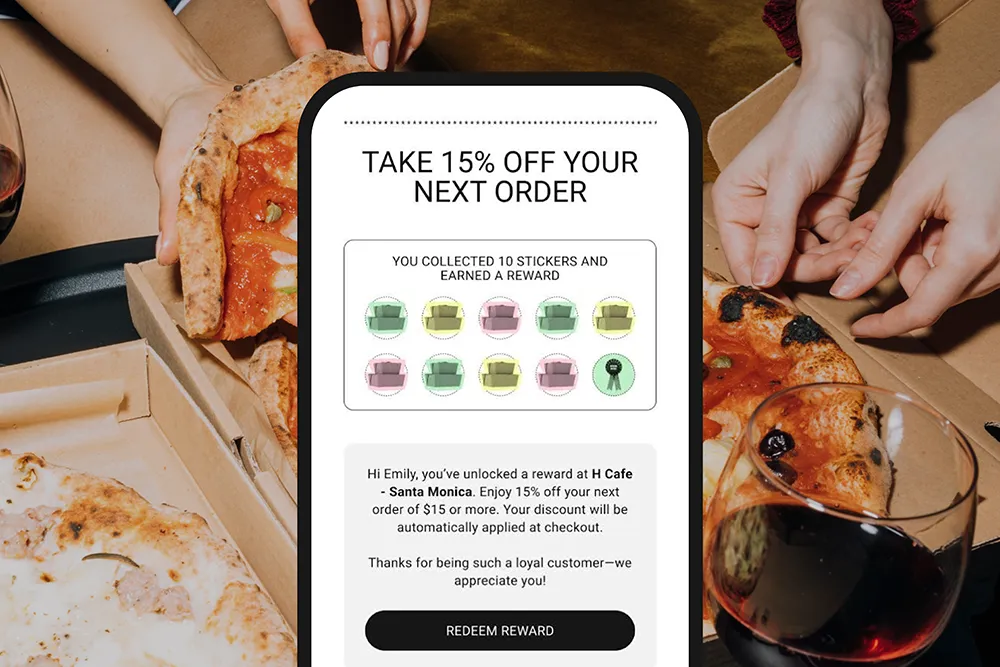
- Digital sticker (or “punch card”) programs reward diners after a set number of orders. Order ten times, get a reward. Simple, visual, easy for diners to track, easy for operators to set up.
- Points-based programs award points per dollar spent, which diners redeem for menu items or discounts. More flexible, but more complex to communicate.
- Tiered programs unlock better rewards as diners cross spending thresholds. Powerful for high-volume operators, often overkill for independents.
For most independents, digital sticker-based is the recommended default. It’s the structure ChowNow’s Rewards Program is built around for a reason: it’s the easiest to launch, the easiest to explain to diners, and the easiest to keep running without ongoing maintenance.
Tie it to ordering, not a separate app
This is the decision that determines whether your loyalty program compounds or stalls. A loyalty program that runs as a separate app — with its own sign-up, its own login, its own customer database — creates friction at every step. Diners forget to enroll. They forget their account. Their data lives in one system while their order history lives in another. The program becomes a side project rather than a retention engine.
A loyalty program built into your ordering platform does the opposite. Diners are auto-enrolled when they order. Rewards track automatically. Their loyalty data, their order history, and their marketing contact info are all in one system — so the next campaign you send can target them based on what they’ve actually bought.
Set realistic earning and redemption rules
The most common mistakes are at the two extremes: rewards that are too generous (you lose money on every redemption), too stingy (diners never reach a reward and disengage), or too complex (diners don’t understand how to earn or redeem). For most operators, a sticker-based program with a clear threshold and a meaningful but margin-safe reward (a percentage discount, a free side, a free item under a certain value) is the right balance.
Are restaurant loyalty programs actually worth it?
Yes, when designed around repeat-visit behavior. The math is direct: a loyalty member spends roughly 20% more than a non-member, and the cost of bringing a loyalty member back for another order is a fraction of what it costs to acquire a new customer. Across a year, even modest loyalty enrollment compounds into meaningful repeat revenue.
Where loyalty programs fail to deliver isn’t the concept — it’s the implementation. Programs that diners can’t find, can’t understand, or can’t access without extra friction don’t generate the lift. Programs that are wired into the ordering flow, where every order builds toward a reward and every reward is one click to redeem, do.
The retention play extends beyond the reward itself. A loyalty member is also a marketing contact — someone you can reach with promotions, win-backs, and seasonal campaigns. Pairing loyalty with Email & SMS Marketing is where independent operators see the strongest compounding effect on repeat orders.
For more campaign-level tactics that work alongside a rewards program, 17 Restaurant Promotion Ideas covers the offers and hooks that consistently drive engagement.
What restaurant loyalty programs integrate with online ordering?
Four categories cover most of the market:
- Ordering-platform-integrated loyalty (like ChowNow Rewards). Loyalty is built into the same system that handles your direct online ordering. One customer database, no separate enrollment, rewards track automatically.
- POS-bundled loyalty (like Toast Loyalty, Square Loyalty). Loyalty lives in the POS. Works if your entire stack — including online ordering — runs through that POS. Limited if your direct ordering happens elsewhere.
- Standalone loyalty apps. Separate platforms that diners enroll in independently. Functional, but creates a parallel system that doesn’t share data with your ordering platform.
- Third-party marketplace loyalty. Loyalty programs offered by delivery marketplaces keep the customer in the marketplace’s ecosystem, not yours. The loyalty member is theirs, not yours.
The integration question matters because loyalty data and ordering data only generate compounding returns when they live together. A diner who’s three orders away from a reward should be visible to your marketing automation; their order history should inform their next message; their reward redemption should feed back into your reporting. That only happens when loyalty and ordering are part of the same platform.
For an independent restaurant running direct online ordering, ChowNow Rewards is the option built around this principle from the start.
Top digital rewards platforms for small restaurants
Here’s how the landscape breaks down for an independent operator:
- ChowNow Rewards. Best for independent restaurants running direct online ordering. Loyalty is built into the same platform as ordering and marketing, so enrollment happens automatically, rewards track automatically, and loyalty members feed directly into Email & SMS Marketing campaigns.
- Toast Loyalty. Works well if your entire restaurant runs on Toast — POS, ordering, and loyalty all in one ecosystem. Limited if your direct ordering happens outside Toast.
- Square Loyalty. Same shape as Toast: strong if you’re all-in on the Square ecosystem, less useful if your direct ordering is on another platform.
- Standalone loyalty apps. Range of options exist, but most require diners to enroll in a separate system and don’t share data with your ordering platform. Best fit for operators who specifically want loyalty as a standalone investment.
The deciding factor for most independents is whether the loyalty program sits inside the system that already handles your direct ordering. If it does, you get one customer database, one set of contact records, and one reporting view. If it doesn’t, you get two of everything.
Best loyalty program software for independent restaurants
The best loyalty program software for independent restaurants is one that’s built into your direct ordering platform, runs digital rewards automatically, and connects loyalty data to your marketing without extra setup. For ChowNow operators, that’s ChowNow Rewards.
The criteria that matter most:
- Integrates with your direct online ordering. Loyalty has to live where the orders happen. If it doesn’t, enrollment friction kills participation.
- No separate app for diners. Asking diners to download a loyalty app on top of your ordering experience is the fastest way to lose them. The best programs run inside the ordering flow they’re already using.
- Captures customer data automatically. Every loyalty member should become a marketing contact you can reach for future campaigns. If the loyalty platform keeps that data to itself, the program is leaving the most valuable part of itself on the table.
- No commission on orders. A loyalty program should grow your revenue, not take a percentage of it. Programs that charge per-order commission on top of subscription costs squeeze margins on every redemption.
- Simple to set up and explain. The operator side should be one-time configuration; the diner side should be self-explanatory.
ChowNow Rewards meets all five. So does Thai District, an independent operator that paired loyalty mechanics with their direct ordering channel and built it into a sustainable engine for repeat sales — the kind of compounding result that’s only possible when loyalty and ordering work as one system.
POS-bundled options (Toast, Square) hit some of these criteria but are conditional on you running your direct ordering through that POS. Standalone loyalty apps tend to miss the data and integration criteria altogether.
How ChowNow Rewards drives repeat orders
ChowNow Rewards isn’t a separate loyalty tool — it’s the loyalty capability of the ChowNow platform. Diners are auto-enrolled when they order through your direct online ordering site or branded mobile app. Stickers accumulate automatically with every qualifying order. When they hit the threshold you set, the reward unlocks and applies on their next order with no extra steps.
The compound effect is where it gets interesting. Every loyalty member is also a marketing contact, which means your Email & SMS Marketing campaigns can target them based on their loyalty status: a reminder when they’re one sticker from a reward, a win-back when they go quiet, a thank-you when they redeem. Rewards gives diners a reason to come back; Email & SMS Marketing makes sure they hear about it at the right moment. Together they form the retention engine independent restaurants need to compete with chains that spend millions on the same outcome.
Getting started with restaurant loyalty
A loyalty program isn’t a product you add to your operation. It’s a way of running the operation you already have — one where every order builds a relationship, every relationship feeds your marketing, and every marketing campaign drives the next order.
That’s how ChowNow approaches it. Direct online ordering, Rewards, and Email & SMS Marketing all run on the same platform, so loyalty isn’t a side project — it’s the connective tissue between your customers and your repeat revenue.
The Repeat Customer Kit walks through the full retention playbook for independent operators. When you’re ready to see how a loyalty program connected to direct ordering and marketing would work for your restaurant, book a demo and we’ll walk through it together.