Restaurant SMS Marketing: How to Drive More Orders Today
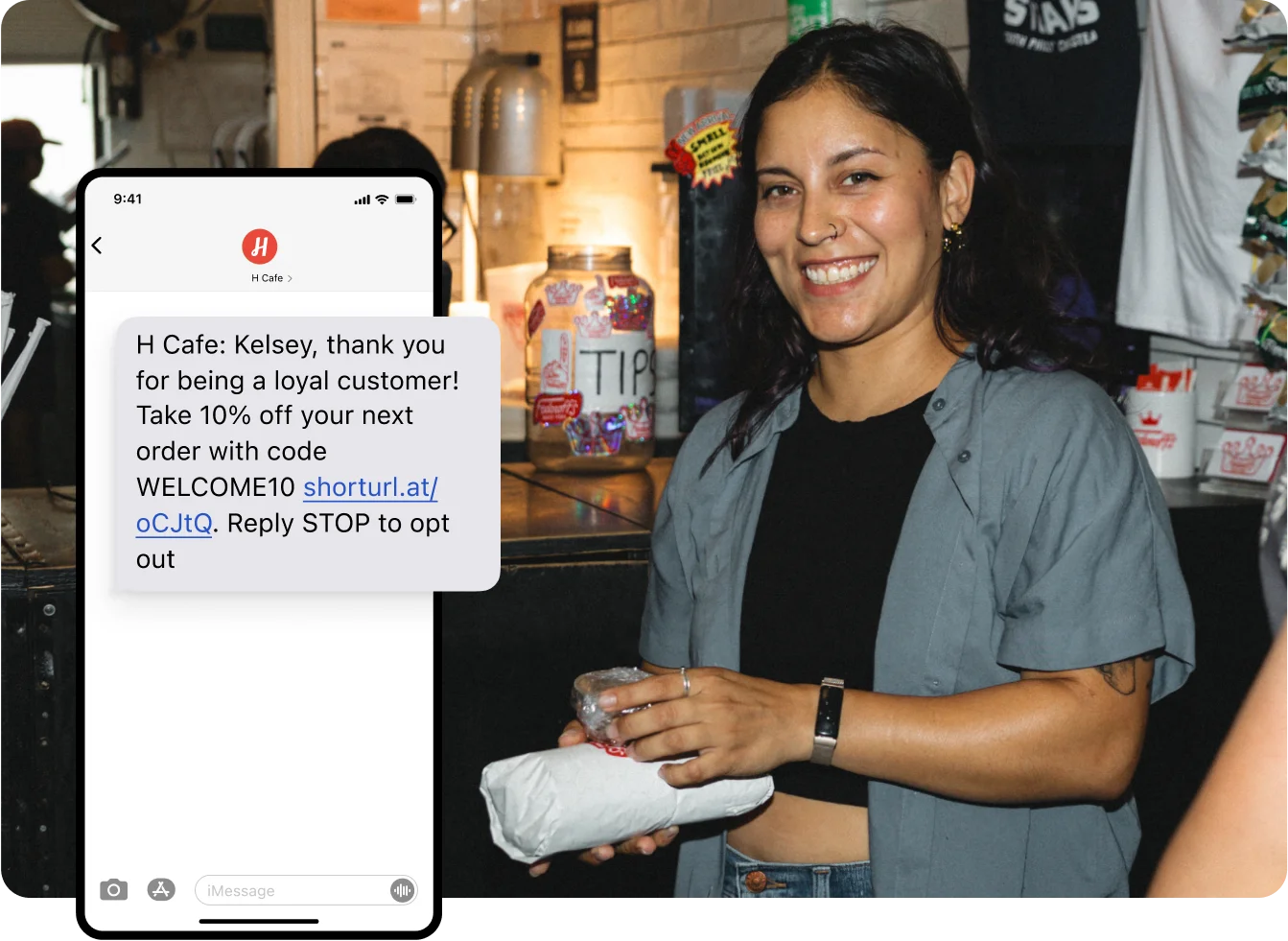
If you want to fill a slow Tuesday lunch, send an email on Monday night and a text on Tuesday morning. The email builds the relationship. The text drives the order.
That’s the core of restaurant SMS marketing: it’s not a replacement for any other channel. It’s the fastest path from message to action. Ninety percent of text messages are read within 3 minutes of receipt. No other marketing channel gets anywhere close to that window — and for restaurants, where the decision of where to eat is made within hours of the meal itself, that speed is everything.
This guide covers exactly how to use it: the campaign types that convert, the timing that maximizes results, and what separates a text that drives an order from one that gets ignored.
Why SMS Is the Fastest Way to Drive Restaurant Orders
The comparison to email is useful because it clarifies what SMS is actually for.
Email open rates for restaurants average 20–30%, and messages are often read hours or days after they’re sent. That makes email excellent for lifecycle campaigns — welcoming new guests, building loyalty over time, reactivating someone who’s been quiet for 60 days.
SMS operates on a different timescale entirely. With a 90%+ open rate and an average read time under 3 minutes, a text message lands when the guest is available right now — which is exactly the right moment for a same-day promotion, a slow-period boost, or a limited-time offer that expires tonight.
The result: SMS drives roughly 5x higher engagement than email alone, according to ChowNow platform data. That’s not because it’s a better channel in the abstract — it’s because it’s a better channel for a specific job: creating immediate action.
For restaurants, that job comes up constantly. A slower-than-expected lunch. A Tuesday that needs a push. A special running tonight that you want people to know about before they make a reservation somewhere else. Those are SMS moments. Email won’t get there in time.

Want more like this in your inbox? Subscribe to ChowNow Feed.
The Best SMS Campaign Types for Restaurants
Not all text messages perform the same way. These four campaign types consistently drive the highest conversion for independent restaurants.
Lunch and dinner pushes are the most common and most reliable use case. A message sent 90 minutes before a meal period — when guests are starting to think about food but haven’t committed yet — is the most effective timing in restaurant SMS. The offer doesn’t need to be dramatic. A reminder that you’re open, what’s good today, and a direct link to order is often enough.
Slow day boosts are where SMS earns its keep most clearly. When a shift is tracking below expectations, a targeted text to your repeat or lapsed guest segments can generate orders within the hour. No other marketing channel moves that fast. The key is having the message ready to go and a guest list segmented enough to reach the right people.
Limited-time offers — a flash special, a weekend-only item, a promotion tied to a local event — need to land immediately or they miss the window entirely. SMS is the only channel that reliably delivers in the right time window.
Win-back messages with an offer bring a specific urgency to reactivation that email alone can’t match. A lapsed guest who gets a text saying their reward is about to expire — or that you miss them and here’s something for their next order — has a much shorter path to action than the same message sitting in an email inbox.
Examples That Actually Convert
These are real-style messages built around the campaign types above. The format that consistently works: short, specific, one clear action, direct link.
Lunch push: “Lunch is on us today. Grab our [item] special — only available until 2pm. Order now: [link]”
Slow day boost: “Today only: free [item] with any order over $20. Because Tuesdays deserve something good. Order here: [link]”
Limited-time offer: “Last day to try our [seasonal item]. After tonight it’s gone. Order before we sell out: [link]”
Win-back: “It’s been a while. Come back this week and we’ll take $5 off your next order. Offer expires Sunday: [link]”
Reward reminder: “You’ve got a reward waiting. Use it before it expires this Friday: [link]”
Notice what every example has in common: a reason, a deadline or constraint, and one link. Nothing extra.
Timing Strategy That Drives Results
The same message sent at the wrong time underperforms dramatically. Timing is the variable most operators underestimate, and it’s the easiest one to get right.
Dayparting — match your send time to the meal decision window:
The meal decision window is narrow. Guests decide where to eat for lunch between 10:30am and noon. Guests decide on dinner between 3:30 and 6pm. A promotional text that arrives at 8pm for a dinner you’re trying to fill is too late to change behavior — the decision was already made.
Behavior-based triggers remove the timing question entirely for certain campaign types. A win-back message that fires automatically when a guest hits 30 days of inactivity doesn’t require you to think about timing, it sends at exactly the right moment by definition. Same for a reward reminder that fires when a guest has an unredeemed offer. These automated triggers consistently outperform manually scheduled campaigns because the timing is personal, not arbitrary.
Why Some SMS Campaigns Don’t Work
Most underperforming SMS campaigns fail for one of three reasons:
- Poor timing. A text that arrives after the decision window has closed — or at a moment when the guest isn’t thinking about food — gets dismissed or ignored. The same offer sent 90 minutes earlier would have converted.
- No urgency. “Come visit us soon” is not a call to action. Guests need a reason to act now rather than later, and “later” almost always means never. Every SMS should include a deadline, a constraint, or a specific time window: today only, tonight, expires Friday, while supplies last.
- A weak or unclear offer. The bar for a text is different from an email, there’s less context, less space, and no visual to support the message. The offer has to be immediately obvious and worth the 3 seconds it takes to read. “20% off today” is clear. “We have exciting new menu additions you should check out” is not a campaign.
- Too many messages. SMS works because it feels direct and personal. The moment it starts feeling like spam, opt-outs increase and future messages lose their impact. Most restaurants see the best engagement at 2–4 texts per month. Beyond that, frequency becomes the obstacle.
How to Increase SMS Conversion Rates
Once timing is right and the campaign type is matched to the goal, three elements determine whether a message converts.
A strong, specific CTA. “Order now,” “Claim your offer,” “Reserve your table” — all of these work. “Click here” does not. The guest should know exactly what they’re being asked to do and what happens when they do it. One link per message. No competing actions.
A clear incentive. The incentive doesn’t have to be a discount — it can be scarcity (“only 20 portions left”), exclusivity (“for our regulars only”), or timing (“today only”). What it can’t be is vague. If a guest has to think about whether the offer is worth acting on, you’ve already lost them.
Simplicity. The most effective SMS campaigns are 2–3 sentences. There’s no room for context, backstory, or explanation. One reason, one offer, one link. If you can’t say it in under 160 characters, cut it down until you can.
Rewards as the incentive. When a guest has a reward waiting, that’s the strongest possible reason to act. A text that says “your reward expires this week — use it here: [link]” converts at a higher rate than almost any promotional offer, because the guest has already earned it. Connecting SMS campaigns to your rewards program is one of the fastest ways to improve conversion without changing anything else.
How to Launch SMS Campaigns in Minutes with ChowNow
The reason most independent restaurants haven’t tried SMS marketing isn’t skepticism — it’s that adding another tool to manage feels like the wrong trade. A channel that creates more work than it drives in orders isn’t worth it.
ChowNow’s SMS marketing is built into the same dashboard as your ordering and email marketing, which means the guest data, the segments, and the campaign editor are all already there.
Pre-built automations handle the recurring campaigns. Win-back messages, reward reminders, and behavior-triggered sends run automatically based on real ordering data — no manual scheduling, no list management, no ongoing maintenance.
On-demand campaigns send in minutes. When you need to push a slow shift or get a limited-time offer in front of guests fast, the built-in editor has your branding loaded and your segments ready. From idea to send in a few clicks, without leaving your ChowNow dashboard.
Your full guest list is already connected. Online customers, dine-in guests captured through QR Code Ordering, and on-premise walk-ins you’ve uploaded via CSV — all in one place, all reachable through the same campaign.
See what’s included in our Pricing Plans
Frequently Asked Questions
Is email or SMS better for restaurant marketing?
Neither is universally better — they serve different purposes. SMS drives immediate action and is best for same-day promotions and time-sensitive offers. Email builds relationships over time and is best for lifecycle campaigns, retention, and announcements. The most effective restaurant marketing uses both channels together in sequence.
How often should restaurants send SMS marketing messages?
Less is more with SMS. Most restaurants see strong engagement with 2–4 texts per month, focused on genuinely relevant moments — a slow period promo, a limited-time offer, a win-back message for lapsed guests. Sending too frequently reduces opt-in rates and erodes the directness that makes SMS effective.
Do restaurant email campaigns actually drive orders?
Yes. ChowNow platform data shows restaurants with a 1,000-diner email list generating approximately $10K in annual attributed revenue from automated email campaigns alone. Targeted, segmented campaigns drive 77% of total email revenue — significantly outperforming generic list blasts.
What’s the difference between automated and on-demand campaigns?
Automated campaigns run continuously based on guest behavior — a welcome email after a first order, a win-back message after 30 days of inactivity. On-demand campaigns are one-time sends you create and schedule yourself for specific moments like promotions, events, or new menu launches. Both types are included in ChowNow’s Marketing Suite.
Do I need separate tools for email and SMS marketing?
Not with ChowNow. Email and SMS marketing are built into the same platform as your ordering system, so your campaigns are automatically powered by real guest data — no integrations, no exporting lists, no switching between tools.