Why Restaurant Operators Should Own Their Online Ordering

For many restaurant operators, online ordering feels like an easy win—more orders, more visibility, and less time spent fielding phone calls.
But there’s a hidden trade-off.
When you rely on third-party platforms to manage your online ordering, you’re handing over more than convenience.
You’re giving up profit, customer data, and control of your brand experience.
Most operators don’t realize the impact until they see the fees eating into each order or try to reconnect with customers who ordered through a third-party platform—only to find they never received their contact information in the first place.
Owning your online ordering isn’t just about cutting out middlemen. It’s about protecting your margins, strengthening your brand, and building direct relationships with the people who love your food.
In this article, you will learn:
- The hidden ways third-party apps limit your business
- How direct ordering puts you back in control
- Why owning your data and branding drives long-term success
The Hidden Cost of Convenience
On the surface, signing up for a third-party ordering app can seem like a lifeline. They handle the logistics, bring in orders, and require almost no setup. But that convenience comes with a price that isn’t always obvious.
Convenience comes at the expense of profit and control
Third-party platforms make online ordering seem effortless; they handle the technology, payments, and even delivery drivers.
The problem is the cost that comes with each order.
Between service fees, 20% to 30% commissions, and marketing boosts, your margins get sliced up before the food even leaves the kitchen. What starts as just a percentage of each sale turns into thousands of dollars every month.
And money isn’t the only thing slipping away.
Many operators don’t realize they’re giving up data, branding, and customer relationships
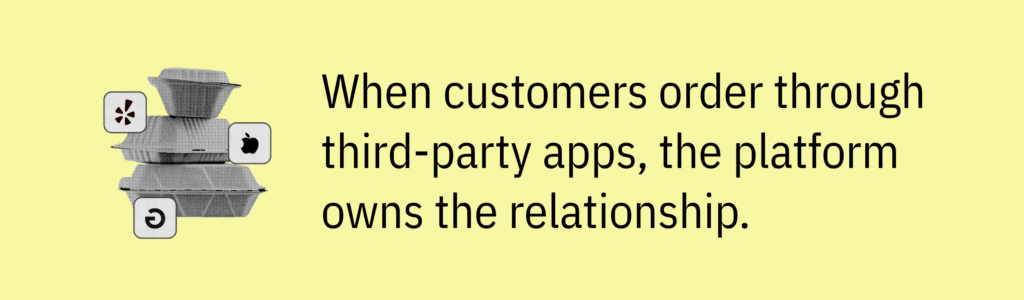
When customers order through third-party apps, the platform—not your restaurant—owns the relationship.
This means that you don’t own your customer data, you can’t follow up to learn about their experience, and you can’t market to them directly to encourage another repeat visit and build loyalty.
Because of this barrier between you and your customer, you’re left competing with hundreds of other restaurants on the marketplace for diners’ attention. Even if you deliver outstanding food, the customer remembers the app, not you.
Without visibility into who your customers are or how to reach them again, you lose the ability to build lasting relationships or turn one-time diners into regulars.
You Lose Control When You Don’t Own It

Third-party apps are great for visibility and volume—they get your name in front of new people who may not have discovered you otherwise.
But when third-party apps become the primary channel instead of a supplemental one, the platform gains control over the customer relationship, the ordering experience, and ultimately your profitability.
The platform, not your restaurant, becomes the customer’s point of connection
Customers aren’t browsing your website or mobile app—they’re scrolling through a marketplace. Before they even reach your menu, they’ve already seen dozens of other restaurants.
At that moment, you’re not the destination. You’re a choice among competitors. And because the customer’s interaction is with the platform, that’s who they build loyalty with, not you.
Without a direct ordering channel, you have no way to continue the relationship after that first order. That means no:
- Email to follow up with
- Phone number to invite them back
- Ability to make them regulars
And when you can’t directly reach the people who already love your food, repeat business gets harder and more expensive.
Without access to customer data, repeat orders become unpredictable
Third-party platforms protect customer information because it fuels their business model—not yours.
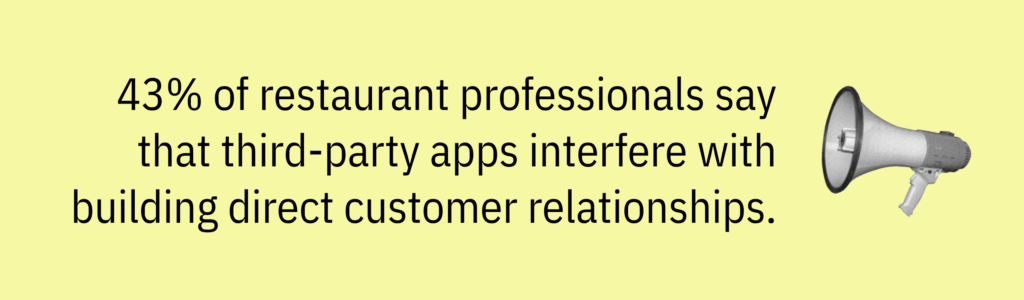
43% of restaurant professionals say that third-party apps interfere with building direct customer relationships because of withheld data.
They keep those emails, phone numbers, and order history to themselves, which means you can’t re-engage diners on your terms. You lose the ability to send promotions, offer rewards, or even understand customer behavior over time.
And even when your food wins them over, something else slips away.
When the platform controls the ordering experience, your brand fades into the background
From the interface to the confirmation screen, the ordering experience is branded for the app. The diner remembers the platform that made ordering easy, not the restaurant that prepared the meal.
You handle the operational complexity and the cost of fulfilling the order, while the app gets the credit and the relationship.
When you own your online ordering, the balance shifts. Marketplaces bring new customers in the door, and your direct ordering keeps them coming back.
High Fees, Lost Data, and Missed Relationships

Third-party apps can help generate orders, but they do it on their terms. When they own the transaction, they decide what information you get, how much you profit, and whether or not you ever see that customer again.
Direct ordering doesn’t replace those platforms; it simply ensures you aren’t dependent on a channel you don’t control.
Commission fees take a cut before you ever see profit
Your restaurant carries the cost of producing the meal:
- Ingredients
- Labor
- Packaging
- Utilities
—yet heavy fees reduce your profit margins before the order even walks out the door.
For example, let’s say an order is $45 for the customer. With a conservative commission fee of 20%, the third-party platform immediately takes $9.
That leaves you with $36 before you subtract the cost of food, labor, packaging, and everything else that goes into operating your restaurant.
Owning your online ordering means you avoid hefty commission fees, so you keep more profits where they belong: in your business.
While revenue loss hurts, it’s not the only cost.
Without customer data, you can’t drive repeat business
Apps don’t just handle the order—they own the customer relationship. They keep the email address, phone number, and order history because customer loyalty fuels their business model.
Without that information, you can’t follow up with a thank-you message, send an offer, or invite the customer to order directly next time.
Even a customer who loves your food may never come back, because you have no way to reach them.
Dependence on third-party apps keeps your restaurant reactive, not proactive
Third-party platforms decide how your restaurant is displayed, what competitors show up next to you, and how customers discover you. You’re playing in someone else’s sandbox.
When you own your ordering channel, you control:
- Pricing
- Promotions
- The customer relationship
- Brand experience
Instead of reacting to whatever the app pushes your way, you get to build direct, lasting relationships with diners and keep more revenue in your business.
Owning Your Ordering Means Owning Your Future
If you only view your online ordering as a convenience, you’re missing out on serious benefits to your restaurant.
When you own your online ordering, you gain full visibility into who your customers are, what they love, and how to keep them coming back. It gives you a system you can rely on that isn’t influenced by shifting fees, changing algorithms, or someone else’s priorities.
Direct ordering gives you full control of the customer experience
Direct ordering gives you the freedom to design an experience that reflects your brand.
Guests land on your website or menu and interact with your photos, your voice, and your hospitality—without being nudged toward another restaurant.
There are no distractions, no competing offers, and no scrolling past your competitors to find you.
When guests feel like they’re dealing directly with your restaurant, it strengthens your relationships.

More of every order stays with your business
Every direct order you capture is one where you keep all the revenue. Instead of watching commissions chip away at your profit, more money stays with your team—supporting staff, operations, and growth.
Third-party apps can still play a role for discovery, but direct ordering becomes your home base: a dependable channel where every order counts.
Direct ordering strengthens your brand and builds long-term loyalty
Direct ordering gives you visibility into ordering habits, customer frequency, and top menu items. With that information, you can run targeted promotions, send personalized messages, or introduce your rewards program to encourage repeat visits.
Instead of blasting generic offers into a crowded marketplace, you connect directly with the people who already love your food.
That’s the power of ownership—predictable revenue, stronger relationships, and a brand that grows on your terms.
When You Own Your Ordering, You Own Your Restaurant’s Growth
When you rely on third-party apps alone, your success depends on someone else’s rules. But when you build a direct ordering channel, you take ownership of your customer relationships, your revenue, and the future of your restaurant.
Contact ChowNow to set up your commission-free Direct Online Ordering channel and start keeping more revenue from every online sale.
Direct Online Ordering Frequently Asked Questions
What’s the difference between a third-party app and a direct ordering system?
Third-party apps are marketplaces where customers browse multiple restaurants and place orders through the app. They control the customer relationship, take a commission on each order, and keep customer data.
Direct online ordering is owned by the restaurant—customers are sent straight to your online ordering system or branded mobile app, so restaurants keep the revenue, branding, data, and customer relationships.
How much money can I save by switching to direct ordering?
Most restaurants save thousands per year by reducing or eliminating commissions. When orders come through a direct channel, more of every dollar stays with your business rather than being siphoned off by per-order fees, boosts, and commissions.
Those savings can be reinvested into your team, marketing, or higher-quality ingredients, instead of disappearing into someone else’s platform.
Will I still be able to offer delivery if I don’t use third-party apps?
Yes. Many direct ordering platforms allow restaurants to connect to on-demand courier networks. This means you can still offer delivery as a convenience to your guests, without requiring them to order through a marketplace. You stay in control of the order while still offering the flexibility your customers expect.
How do I get my customers to switch to ordering directly from me?
Make it the easiest choice. Add “Order Direct” buttons to your website and social media profiles, include the link on receipts and takeout packaging, and train staff to mention it during pickup or checkout.
Most customers are happy to support your business directly; they just need to know that direct orders help more of the revenue go to the restaurant instead of third-party fees.
Is it hard to set up a direct online ordering system?
No. It’s much simpler than most operators expect. Most direct ordering platforms handle the setup for you, including menu uploads and onboarding support, so you don’t have to be a tech expert to get started. Once your system is live, you can update your menu, change pricing, and view order data whenever you need, putting you in full control of your online business.