How To Improve Restaurant Profitability: Benchmarks, Strategies, And Tools That Actually Work

Your restaurant’s profitability ultimately comes down to understanding two things:
- How much money is coming in
- How much money is going out
On the surface, it sounds simple enough, but tracking the flow of sales and expenses in real time across food, labor, overhead, and the small operational costs that add up can be surprisingly complex.
Profitability isn’t only about cutting costs; it also depends on finding smart ways to grow revenue, whether that’s increasing your average check size, driving repeat orders, or finding new channels to grow sales.
Without clear systems and strategies in place, it’s easy to miss both where profits are slipping away and where new gains could be made.

In this guide, we’ll break down what profitability really means in the restaurant industry, the core metrics you need to monitor to keep your costs under control, and the key strategies you can use to grow your bottom line.
You’ll also see how smart use of restaurant technology—from direct online ordering to loyalty programs and automation software—can help you reduce costs, attract more customers, and create long-term stability.
By the end, you’ll have a clear picture of where your restaurant’s financial health stands today and what steps you can take to secure long-term success.
Understanding Restaurant Profitability
Before you can improve your restaurant’s profitability, it helps to understand what it really means. In simple terms, profitability is the money your business keeps after covering all of its expenses.
For restaurants, that means subtracting food costs, labor costs, and overhead costs from your total revenue. What’s left is your net profit—the portion that actually makes it into your pocket.
There are three main ways to measure a restaurant’s profitability:
Gross, Operating, and Net Profit
- Gross Profit Margin: Your total sales minus the cost of goods sold (mainly food and beverage). This shows how efficiently you’re creating menu items compared to what you’re charging for them.
- Operating Profits: This takes it a step further by subtracting operating expenses like rent, utilities, and payroll taxes. This figure gives you a clearer picture of your day-to-day financial impact.
- Net Profit Margin: What’s left after all expenses are paid—including interest, taxes, one-time costs, and variable costs. This is your actual bottom line and the number most restaurant owners focus on because it reflects the true profitability of the business.
Industry benchmarks for different restaurant types
What makes a “good” restaurant profit margin largely depends on the restaurant type. For example, quick service restaurants typically run on tighter margins but benefit from having much higher sales volume.
Full-service restaurants and fine dining establishments tend to have higher labor expenses and other expenses, but they also have opportunities for higher margins per guest. Knowing the industry average for your restaurant type helps you set a baseline and establish realistic expectations and goals.
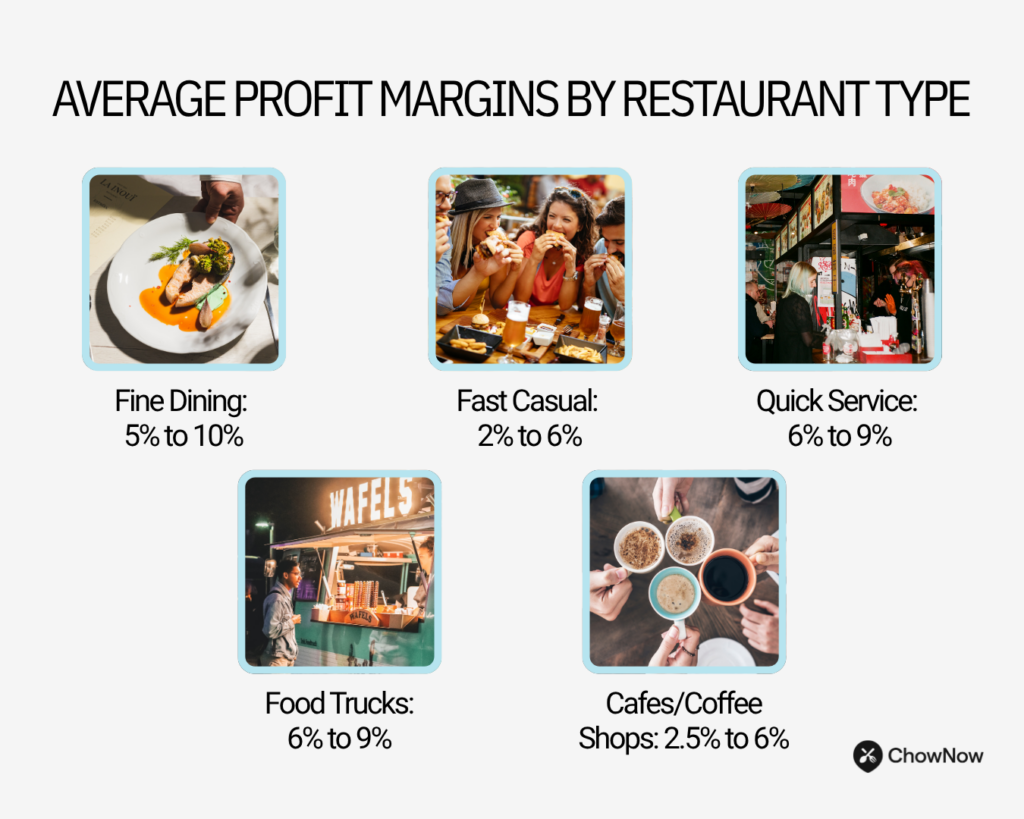
The following breakdown highlights the average restaurant profit margin across some of the most common concepts:
- Fine dining/full service restaurants: 5% to 10% profit margin
- Fast casual restaurants: 2% to 6% profit margin
- QSR: 6% to 9% profit margin
- Food trucks: 6% to 9% profit margin
- Cafes and coffee shops: 2.5 % to 6% profit margin
The average restaurant profit margin across the entire restaurant industry is typically between 3%-5%.
Comparing your numbers to these industry benchmarks gives you a clear picture of your restaurant’s financial health and helps set realistic goals. From there, you can identify adjustments that move you toward a healthier, more sustainable profit margin.
The importance of setting profit goals
Tracking your restaurant profit margin isn’t just about knowing the numbers—it’s about setting clear financial goals and reviewing them regularly.
That means tracking your profitability on a weekly or monthly basis so you can identify trends, cut back on waste, and take proactive steps to protect your restaurant’s revenue.
Key Metrics That Drive Profitability

Now that we’ve covered what profitability means and how to measure it, the next step is knowing which restaurant KPIs actually drive it day to day. These are the metrics that give you the visibility to understand how efficiently your restaurant is running and where money might be slipping through the cracks.
Food cost percentage
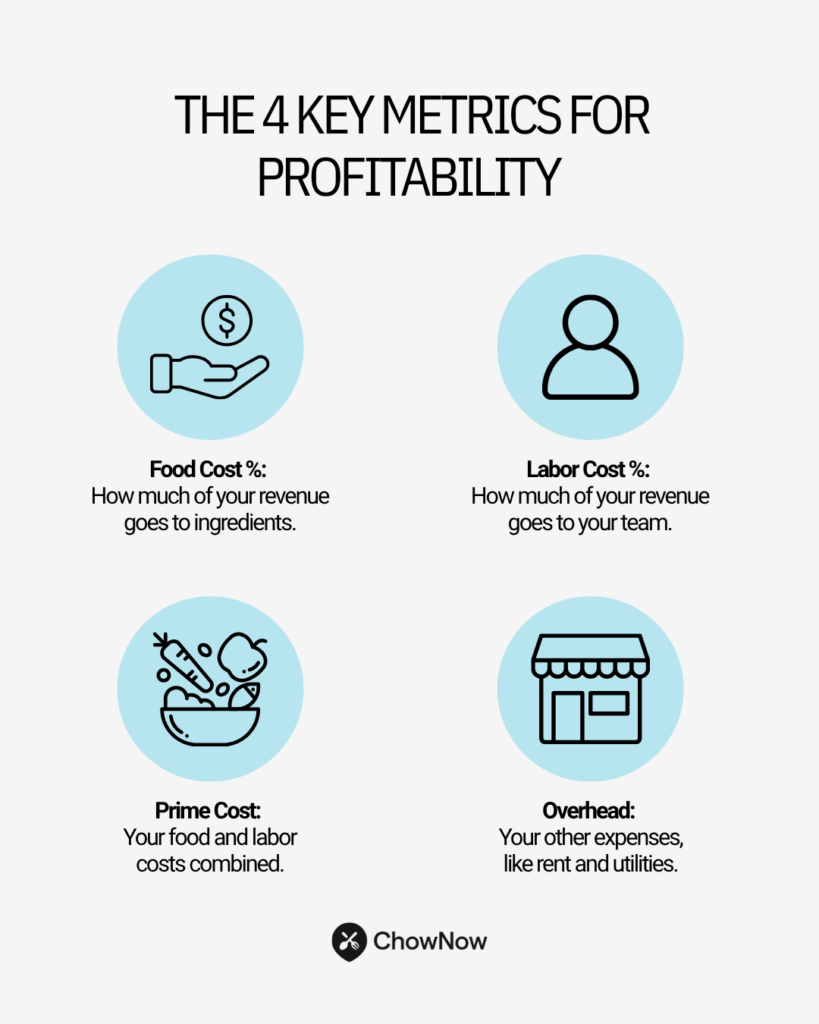
Food is one of your largest controllable expenses, which is why food cost percentage is such an important metric. It’s calculated by dividing the cost of ingredients used by your total food sales for a given period.
For example, if you spent $10,000 on food and beverage purchases in a month and your total food and beverage sales were $35,000, the formula looks like this:
($10,000 ÷ $35,000) × 100 = 28.6%
That means 28.6% of your revenue went to food and beverage costs.
Keeping this number within a healthy range ensures that you’re pricing menu items correctly, purchasing wisely, and limiting waste.
Labor cost percentage
Labor is the other big piece of the puzzle. Labor cost percentage shows how much of your revenue is going toward wages, benefits, and payroll taxes.
Since labor needs often scale with sales, this metric helps you understand whether you’re staffing appropriately for demand. If your labor cost percentage is creeping upward, it’s usually a sign to revisit scheduling practices or look for efficiency improvements.
To calculate it, divide your total labor costs by your total sales, then multiply by 100 to turn it into a percentage.
For example, if your labor cost is $7,500 and your total sales are $25,000, your labor cost percentage is:
($7,500 ÷ $25,000) × 100 = 30%
That means 30% of your revenue is going toward labor.
Prime cost
Prime cost combines food and labor costs into one figure. Because these two categories typically make up the majority of a restaurant’s expenses, prime cost is a powerful indicator of overall financial health. Monitoring it closely allows you to spot problems early and keep a tighter grip on profitability.
Other operating expenses
Beyond food and labor, every restaurant has other fixed and variable expenses—things like rent, utilities, insurance, and administrative costs.
These may not change much week to week, but they add up quickly. Knowing exactly how much of your revenue goes toward operating expenses helps you understand your true break-even point.
Building a simple reporting process
Tracking these metrics is only useful if you make it a regular habit. Building a simple process of pulling up the numbers through your POS, accounting software, or dashboard makes it easy to review data weekly.
This way, you’re not just collecting data, you’re building the foundation for smarter decisions about food, labor, and overhead.
Keeping Your Core Costs Under Control

Once you’re tracking the right metrics, the next step is using them to manage the areas that have the biggest impact on your profitability:
- Food
- Labor
- Overhead
Together, these core costs account for the majority of your spending, but they’re also, fortunately, the ones you have the most control over on a day-to-day basis.
With the right systems and strategies in place, you can manage each one effectively and turn numbers on a report into real profitability.
Food Costs: Control what’s on the plate and minimize waste
Food costs can get out of control very quickly if they’re not closely monitored, but it’s also one of the easiest places to find savings.

Start with your purchasing strategies: negotiate with vendors, compare prices regularly, and place orders based on sales forecasts rather than habit. If you can get the initial cost of your ingredients down, the following strategies will be that much more effective.
Next, standardize your recipes and portion sizes to keep every dish consistent, no matter who is prepping or working the line. This means printing and laminating recipe sheets and having scales for weighing product at every station.
Finally, pay close attention to waste. Use inventory software tools to identify gaps between what was purchased and what was actually sold, helping you spot over-ordering, spoilage, and differences in portions.
Also, as you’re working the floor, watch out for what customers are leaving on the plate when they’re done eating. If you’re seeing leftovers of the same menu item, you either need to adjust the recipe or reduce the portion size, helping you minimize waste.
Labor Costs: Match your staffing to sales
Labor is typically your highest operating cost, and while it’s more challenging to balance than food costs, it’s still manageable. The key is building schedules around projected sales rather than relying on fixed schedules that you copy/paste week after week; that way, you’re aligning labor with actual demand.

Reviewing sales-per-labor-hour benchmarks can also help you measure productivity more accurately. Here’s how to calculate it:
- Add up your total sales for a given period (day, week, or month).
- Add up your total labor hours worked during that same period.
- Divide sales by labor hours.
For example, if your restaurant did $12,000 in sales over a weekend and staff worked a total of 400 hours, the calculation looks like this:
$12,000 ÷ 400 = $30 SPLH
That means you made $30 in sales for every labor hour paid.
Scheduling software makes this process easier by providing data-driven insights, flagging overtime risks, and ensuring you’re not caught understaffed during peak hours. Balancing efficiency with guest service is key here: the goal isn’t just cutting hours, but making sure labor dollars are being spent wisely.
Overhead: Trim hidden costs that quietly drain profits
Overhead can be more difficult to trim because of fixed costs such as rent, property taxes, permits, etc., but you can still make adjustments to your administrative and variable costs.
Regularly review vendor contracts and build relationships with multiple suppliers to get better pricing on raw materials, like paper goods, linen, and cleaning supplies. You can also look at your utility bills to track how much energy you’re using, then possibly make the switch to more energy-efficient tools like LED lighting, motion detector lighting in low-traffic areas, and smart thermostats.
Automation can also play a role in controlling costs. Tools that handle recurring tasks like payroll, invoice management, or tip distribution reduce administrative overhead. Less time spent buried in paperwork means more time to focus on the parts of the business that drive profit.
Next Level Revenue Growth Strategies

Getting your costs under control is only half the battle; to see your restaurant’s profits truly thrive, you need to next focus on strategies that maximize the value of each guest, deepen customer loyalty, and elevate the customer experience.
Menu Engineering and Pricing: Design your menu to highlight profitable dishes
It’s easy to think of your menu as just a list of dishes, but the reality is that when designed correctly, it can be one of your most powerful sales tools.
Using menu engineering tactics, you can identify high-margin dishes and make them more prominent (both on your physical menu and online ordering) to help guide guests toward choices that are good for them and you.

For example, placing a best-selling entree in the top-tight corner of your menu, boxing it in visually, or labeling it as “Guest Favorite” or “Chef Recommended” can immediately draw attention. These subtle design cues work quietly to help profitable dishes stand out without diners realizing they’re being guided.
How you describe your menu items can make a big difference in what diners order as well. Small wording changes, such as highlighting unique ingredients, emphasizing flavor, or suggesting a pairing, can shift orders toward dishes that deliver stronger margins.
The goal isn’t to overwhelm guests with detail, but to present your most profitable items in the most appealing way possible.
Increasing Average Order Value: Get guests to spend more without feeling pressured
The key to increasing your average order value (AOV) is to frame upsells as thoughtful suggestions, not sales tactics. When done well, guests feel like you’re enhancing their meal rather than pushing them to spend more.
One way to do that is through your staff. Training staff to suggest an appetizer, dessert, or drink pairing creates a natural add-on that feels personal and helpful. For example, a simple line like “This dish pairs really well with our house margarita” gives diners a reason to consider something extra without any pressure.

Digital ordering can be approached in the same way. On your online ordering system, you can highlight upgrade options, like adding proteins, swapping in premium sides, or bundling items together. These add-ons give guests a convenient reason to spend a little more while making their meal feel more customized.
To be successful, the suggestions need to feel natural while providing value to diners, helping them discover something new, enjoy their meal more, and leave feeling satisfied, while your restaurant benefits from consistently higher check averages.
Marketing and Loyalty Programs: Turn first-time diners into repeat regulars
Roughly 80% of sales come from your repeat business, which means the more loyal customers you have, the larger your restaurant profits will grow. To keep diners coming back, you need to offer incentives and implement strategies to keep your restaurant top-of-mind.
The first thing you’ll want to do is implement a loyalty program that’s easy for customers to track and redeem rewards. For example, offering a discount after a set number of visits encourages repeat visits while making guests feel rewarded for their loyalty.
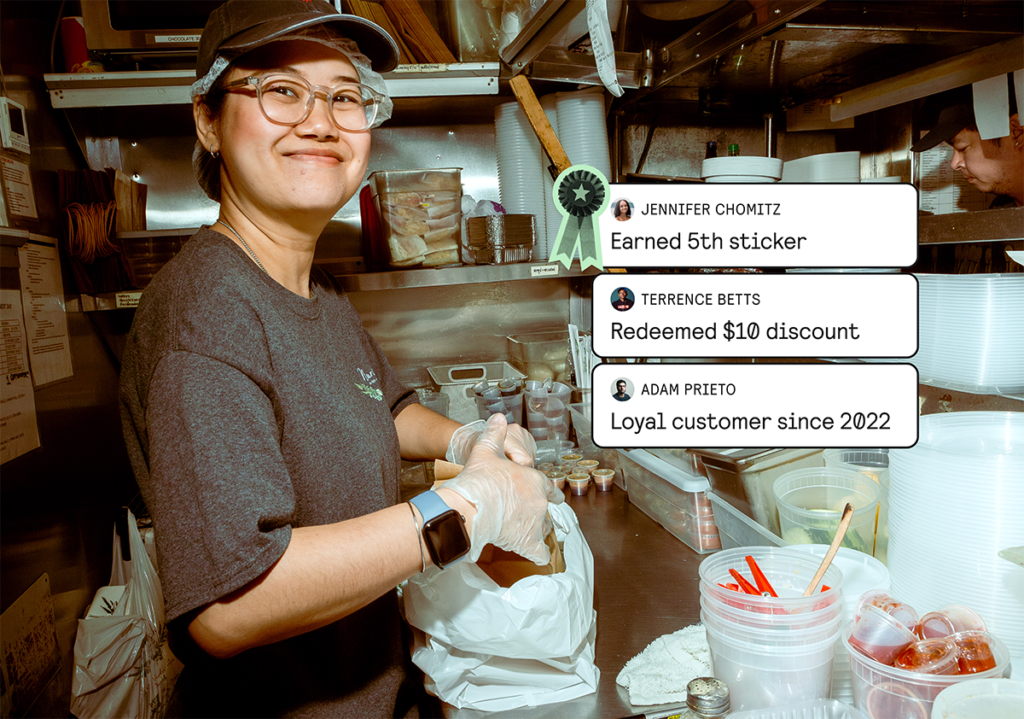
After guests have signed up for your rewards program, you can leverage email marketing to keep your restaurant top-of-mind and encourage repeat visits.
Automated campaigns can welcome new diners after signing up, highlight new specials, and re-engage lapsed guests with an incentive to return. For instance, sending a “We miss you” message to someone who hasn’t ordered in 30 days can be the nudge that brings them back through your door.
Guest Experience: Offer service that fuels reviews and returns visits
How you make customers feel is just as important as how good your food tastes. Those interactions are often the deciding factor in whether a customer returns or heads to one of your competitors instead.
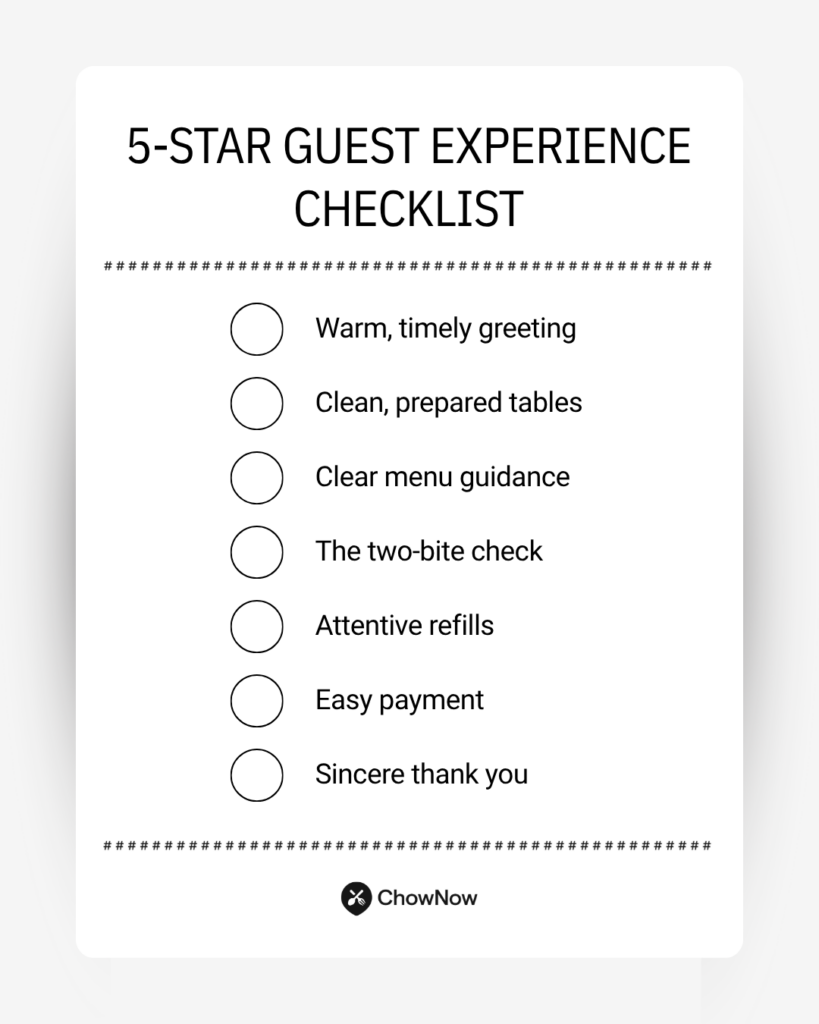
The key is consistency. Customers want to know they’ll receive the same level of service every time they visit, and the best way to do that is to nail down the basics, for example:
- Warm, timely greeting
- Clean, prepared tables
- Clear menu guidance
- The two-bite check
- Attentive refills and resets
- Easy payment
- Sincere thank you, and goodbye
There’s nothing groundbreaking about these touchpoints, but when done well, they make your guest experience one that will create lasting customer relationships.
Consistency extends to digital orders as well. Clear order confirmations, accurate delivery estimates, and packaging that keeps food fresh show guests that the same care goes into takeout as dining in. When customers feel like they can trust your restaurant to get it right every time, they’re much more likely to return.
Satisfied guests often become your best advocates. A simple prompt at the end of a visit—such as a server saying, “If you enjoyed your meal, we’d love a review online” or a note at the bottom of your receipts encourages happy customers to share their experience.
Those reviews build credibility, boost your visibility, and attract new diners who are looking for a place they can count on.
Using Technology to Protect and Grow Profits

Technology isn’t just about convenience; it’s one of the most effective ways to protect margins and make smarter decisions. The right tools reduce manual work, uncover hidden inefficiencies, and help you capture revenue that might otherwise slip through the cracks.
Keep more revenue with direct online ordering
Third-party apps take huge portions of your profits with high commission fees. Setting up direct online ordering through your restaurant’s website and branded mobile app keeps more of each sale in-house.
For example, sharing your direct ordering link on social media and on online listings like Google Business Profile gives customers an easy path to ordering directly from you, saving money on commissions while building stronger relationships with diners.

Use POS data to see what’s really working
Your POS can be used for so much more than just ringing up orders—it’s a goldmine of information. Detailed reporting shows which menu items are most profitable, what times of day drive the highest sales, and where costs are creeping up.
For example, your data might reveal that certain modifiers, such as premium add-ons or substitutions, sell well but aren’t being priced to reflect their true cost, leaving money on the table.
With data like that on hand, you can make decisions based on facts rather than gut feeling.
Automate tasks that take a significant amount of time
Manual admin work is not only time-consuming—it’s prone to mistakes. Automating tasks such as payroll, tip distribution, and invoice management with the right software can reduce errors and free up staff from the hours spent on these responsibilities every week.
Reduced time in the back office means lower labor costs and freeing up time to focus on customer experience.
Grow visibility with built-in marketing tools
Many online ordering systems now include marketing features like automated email campaigns, loyalty programs, and SEO-friendly websites. Instead of juggling multiple vendors, having these tools in one place makes it easier to stay consistent.
For example, setting up an automated “welcome” email for new customers or a loyalty reward for frequent diners keeps your restaurant top-of-mind without requiring extra effort from you or your team.
Making Sure Profits Last Over Time
Profitability isn’t a one-time win—it’s something you need to protect and grow as your restaurant evolves. The most successful operators think beyond this week’s numbers and put systems in place to make sure margins hold steady over the long haul.
Scaling operations without losing control
Expanding into new revenue streams—like catering, meal kits, or off-premise dining—can open doors to higher sales, but growth comes with complexity. The systems that work for dine-in service don’t always fit these new models, and that mismatch can eat into profitability.
Centralizing your technology and standardizing your processes ensures everything runs smoothly, whether you’re updating prices, launching new menus, or overseeing multiple locations. Without that structure, growth often leads to higher costs and operational headaches instead of stronger profits.
Invest in brand equity that pays off
Profitability is easier to sustain when guests feel a long-term connection to your restaurant, which starts with building recognition and trust in your community. Investing in local partnerships, supporting neighborhood events, or collaborating with nearby businesses strengthens visibility and ties your brand to causes people care about.
Carrying that same sense of identity into your digital presence—through your restaurant website, email, and social channels—creates consistency between what guests experience in person and what they see online. When the story you’re telling is aligned across every touchpoint, your restaurant stays top-of-mind and loyalty grows stronger over time.

Adapt to industry trends to stay competitive
Consumer expectations never stand still, and restaurants that adapt early protect their margins. Seasonal menus, dietary shifts like the growing demand for plant-based options, or new service formats all require flexibility. That depends on watching performance data closely, so you can spot changes in customer behavior before they’re obvious.
Staying proactive allows for gradual updates instead of rushed, expensive pivots—keeping your restaurant aligned with demand while maintaining profitability.
Sustaining Profitability for the Long Haul
Sustaining profitability isn’t about one big change—it’s about consistently making smart decisions with your costs, your team, and your guests in mind. By keeping a close eye on the right metrics and staying flexible as the industry evolves, you’ll set your restaurant up for steady growth and long-term success.
Contact ChowNow to learn how Direct Online Ordering and a Rewards Program can help your restaurant grow profitability by driving repeat orders and reducing third-party fees.
Restaurant Profitability Frequently Asked Questions
What is a good profit margin for restaurants?
A good profit margin for restaurants usually falls between 3% and 6% on average, though top-performing restaurants may reach 10% or more. Quick-service restaurants often rely on higher sales volume to offset slimmer margins, while fine dining can see higher margins per ticket but higher costs as well. The “good” margin depends on your concept, location, and operating model, but staying above industry averages is a strong sign of financial health.
What can I do to improve my restaurant’s profitability?
You can improve your restaurant’s profitability by increasing revenue and controlling costs. On the revenue side, focus on raising your average order value with upsells and promotions, and strengthen repeat business through loyalty programs. On the cost side, track food and labor percentages closely, negotiate with vendors, and watch portion control to reduce waste. Even small adjustments—like optimizing schedules or highlighting high-margin menu items—can have a big impact.
How do I reduce my food and labor costs?
To reduce food and labor costs, start by calculating your current percentages so you know where you stand. For food costs, negotiate better pricing with suppliers, use inventory tools to cut waste, and adjust menu pricing if needed. Building schedules around sales trends and using scheduling software prevents overstaffing, cuts overtime, and keeps labor costs aligned with demand. The goal is to keep food and labor (prime costs) within a healthy combined percentage of sales.
What metrics should I track to measure profitability?
The key metrics to track for restaurant profitability are:
- Food cost percentage
- Labor cost percentage
- Prime cost (food + labor combined)
- Overhead expenses (rent, utilities, insurance)
- Sales per labor hour
- Gross, operating, and net profit margins
Together, these metrics show how much money is coming in, where it’s going out, and how much is left at the end.
How can technology improve restaurant profitability?
Technology improves restaurant profitability by making operations more efficient and uncovering revenue opportunities. Online ordering systems capture more sales, loyalty programs increase repeat visits, and automated emails drive guests back without extra work. On the cost side, POS systems, scheduling software, and inventory tools help reduce labor waste and food waste. The right tech keeps you in control of both revenue and expenses.
What role does marketing play in profitability?
Marketing plays a major role in profitability because it helps fill seats and drive orders. Strong marketing attracts new diners and keeps loyal customers coming back, which directly grows revenue. Promotions, social media, and email campaigns can also be designed to highlight high-margin items or encourage online ordering, which boosts average order value. Without consistent marketing, even a well-run restaurant can struggle to reach its full profit potential.
How often should I review my restaurant’s profitability metrics?
You should review your restaurant’s profitability metrics at least monthly, though many operators check weekly to stay ahead of problems. Regular reviews help you spot rising food or labor costs before they cut too deeply into profits. Using POS and accounting tools makes it easier to track metrics in real time so you can adjust quickly instead of waiting for end-of-month reports.