The Best Alternatives to Uber Eats for Independent Restaurants (2026)
If you’re on Uber Eats, you already know the app brings in orders. What’s harder to see is exactly what those orders cost you, and whether there’s a better way to split your business between marketplaces and your own channel.
Here’s the math, plus what independent restaurants are using instead.
What Uber Eats actually costs an independent restaurant
Uber Eats charges restaurants a commission on every delivery order, and as of March 2026, those rates moved higher:
Here’s why that math matters more than it might seem. According to the National Restaurant Association’s 2025 Restaurant Operations Data Abstract, the median full-service restaurant cleared a 2.8% net margin before taxes in 2024; limited-service cleared 4.0%. A 20 to 30% commission on a chunk of your orders isn’t a fee that eats into profit. For a lot of independent restaurants, it’s bigger than the profit.
Uber Eats works best as one channel, not your whole strategy
None of this makes Uber Eats a bad tool. It’s genuinely good at one thing: putting your restaurant in front of diners who’ve never ordered from you before. Where it gets expensive is when it’s the only place diners can find you, order after order, for years.
The fix isn’t leaving Uber Eats. It’s giving repeat diners a cheaper, faster path back to you such as your own website and app while Uber Eats keeps doing the discovery work it’s built for.
The most direct alternative: commission-free ordering on your own website and app
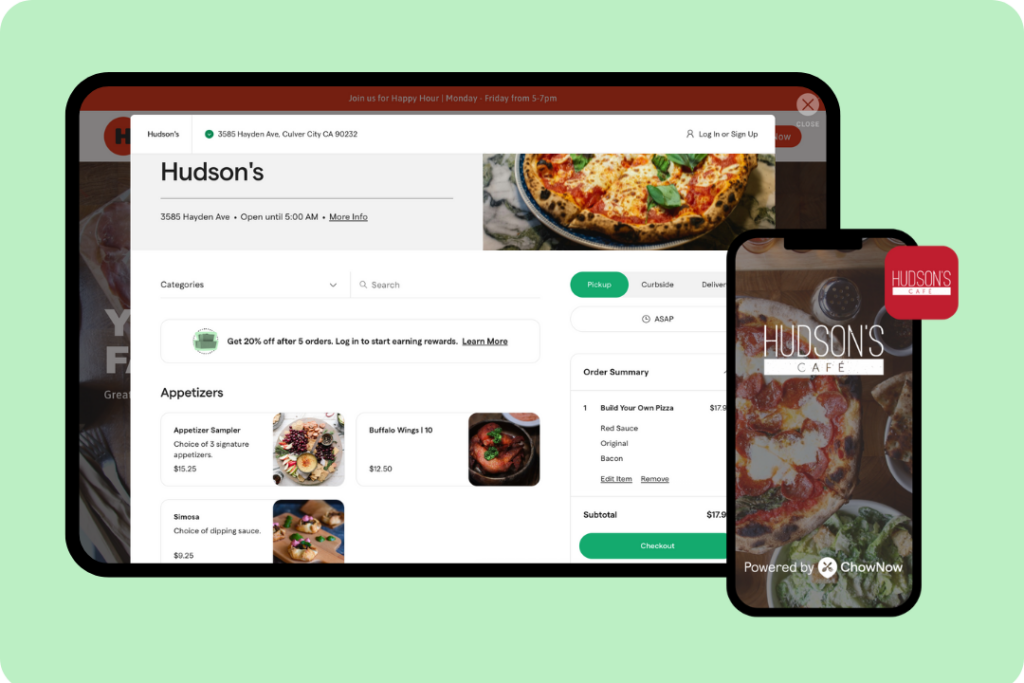
Direct online ordering puts diners on a page and app you own, with zero commission on every order.
ChowNow restaurants save an average of $16K a year this way (based on a 22% commission benchmark), and restaurants with a branded mobile app see up to 2x more direct orders than those without one, since push notifications and one-tap reordering bring diners back without a delivery-app detour.
You also keep the customer data. On Uber Eats, order history and contact info stay with the platform. On your own direct ordering channel, that list is yours, even if you ever switch providers.
Keep Uber Eats and simplify it: order aggregation instead of tablet chaos
If Uber Eats is staying in the mix (it usually should, for discovery), the operational fix is consolidation, not removal.
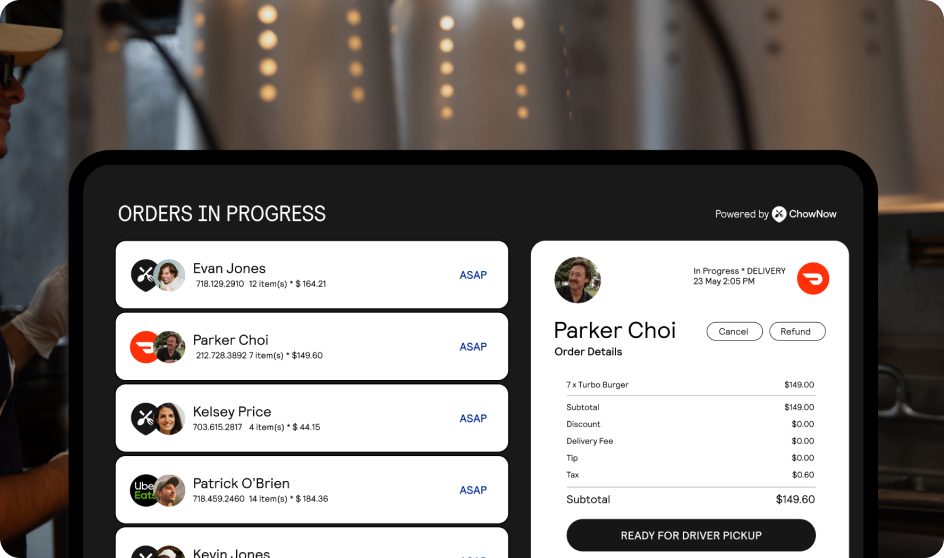
Order aggregation pulls Uber Eats, DoorDash, and Grubhub orders into one dashboard alongside your direct orders, so your kitchen isn’t juggling four tablets and re-keying tickets by hand. Less manual entry means fewer missed orders and fewer labor hours spent babysitting screens.
Get found beyond Uber Eats: Google, Apple Maps, and other discovery channels
Uber Eats isn’t the only place diners search for food. ChowNow’s Discovery Network lists your menu directly on Google, Apple Maps, Yelp, and other high-traffic sites, so you’re not relying on a single app to bring in new diners. It’s a lower-fee way to widen your discovery net without adding another marketplace commission to the pile.
Want to see what commission-free ordering could save your restaurant?
See how ChowNow works or read the full breakdown of direct ordering versus third-party dependence.
FAQ: Uber Eats alternatives for independent restaurants
Do restaurants own their customer data when using Uber Eats?
No. Order history, contact info, and ordering patterns stay with Uber Eats. On a direct ordering channel you control, that data is yours to keep and use.
What’s the difference between ordering through Uber Eats and a restaurant’s own website?
Uber Eats trades reach for a 20-30% commission per order. Your own website or app has no commission, but you’re responsible for driving traffic to it, which is where a branded app and marketing tools do the heavy lifting.
What are the benefits of a branded restaurant app versus using Uber Eats?
A branded app keeps every order commission-free, lets you send push notifications diners actually open, and keeps your brand (not Uber Eats’) in front of the customer at checkout.
What are the best alternatives to Uber Eats for independent restaurants?
Commission-free direct ordering on your own site and app, order aggregation to consolidate the marketplaces you keep, and discovery tools like Google and Apple Maps listings that don’t depend on a single delivery app.