The Ultimate Guide to Restaurant Food Cost: How to Understand, Calculate, and Lower It
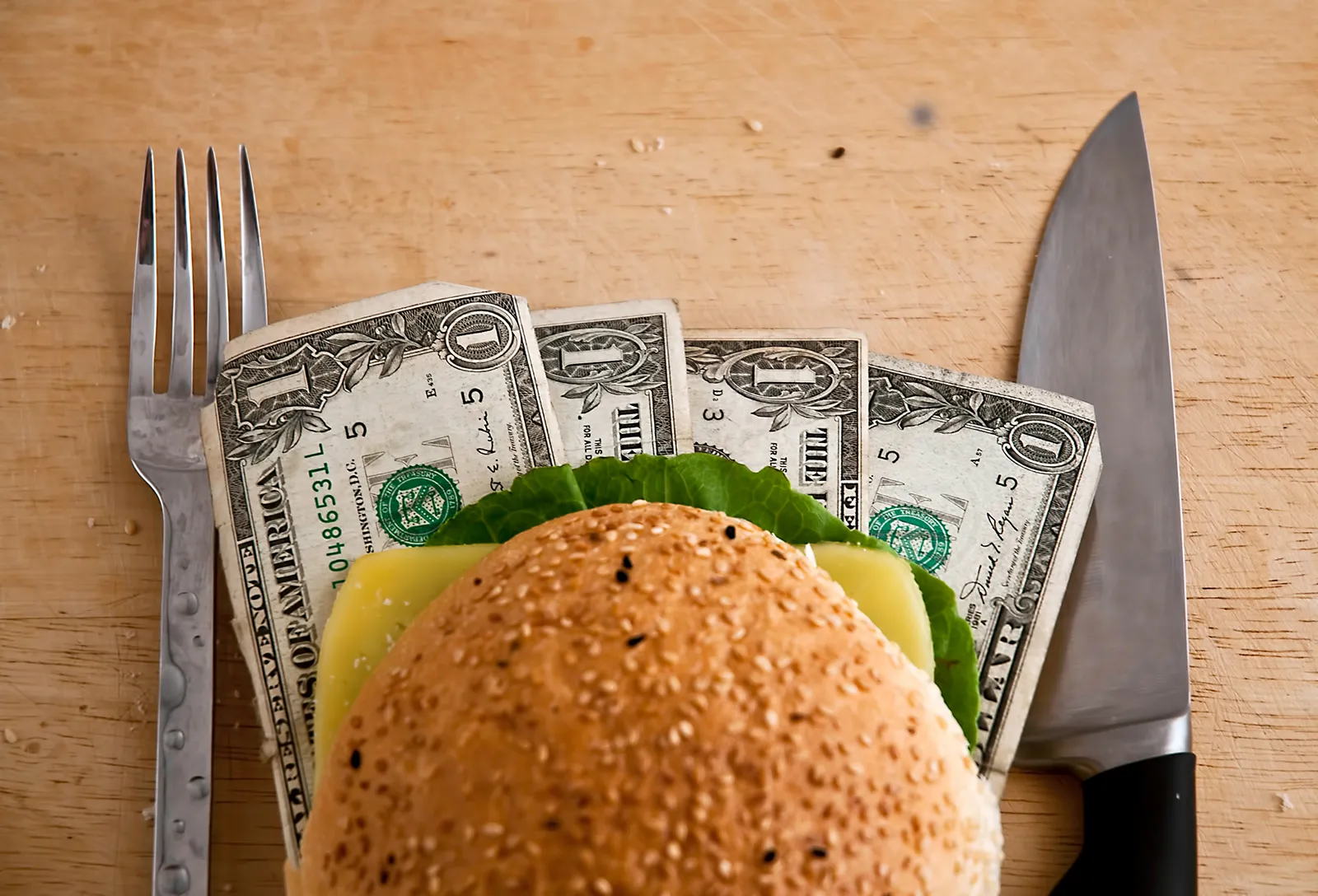
In this guide, we break down restaurant food cost in a way that makes it easy to understand, so you can finally get a clear handle on one of the most important financial metrics in your business.
Restaurant food cost directly affects profitability, menu pricing, and your ability to make informed decisions about what stays on the menu and what needs to change.
When you understand how it works—and how to control it—you give yourself a real path toward stronger margins and more predictable cash flow.
We’ll start by defining what restaurant food cost actually is and why it matters so much. Then we’ll walk step-by-step through the standard food cost formula, how to track beginning and ending inventory, how to factor in purchases, and how to calculate your food cost percentage, using simple numbers to follow.
You’ll also see examples that make the math feel approachable—not intimidating.
From there, this guide outlines the biggest factors that influence your food cost, from ingredients and waste to portioning, vendors, and menu design. We’ll also cover proven cost-control strategies you can put into practice right away—without sacrificing quality or the guest experience.
What Is Restaurant Food Cost and Why Does It Matter?
Before you can manage your restaurant food cost, you need to clearly understand what it is, where it fits into your broader financial picture, and why it has such a big impact on your success.
Let’s break it down piece by piece.
What Is Food Cost, Really?
Your restaurant food cost represents the total dollar amount spent on the ingredients and raw materials used to make the menu items you sell. It’s typically measured as a percentage of your total food sales, showing how much of every dollar earned goes toward food.
For example, if you spend $3,000 on ingredients in a given week and generate $10,000 in food sales, your food cost percentage is 30%.
This means 30% of your revenue went to paying for ingredients—and the remaining 70% must cover your labor cost, overhead expenses, and profit.
How Food Cost Shapes Profitability, Pricing, and Cash Flow
Your restaurant’s food cost percentage directly impacts how profitable your business can be. When food costs rise without a change in pricing or how efficiently you can produce menu items, your profit margins narrow.
When you actively manage costs—by tracking inventory, negotiating with vendors, and reducing waste—you can keep your margins healthy while maintaining the same level of quality.
Regular tracking helps you spot trends early, avoid unpleasant surprises, and stay ahead of seasonal or market shifts in ingredient costs.
Why Tracking Food Cost Leads to Better Business Decisions

Food cost is second only to labor cost as the biggest expense for most restaurants. Together, they make up what’s called your prime cost—one of the most important KPIs to track because it typically accounts for 60-65% of total operating expenses.
Because food cost makes up such a large percentage of your spending, when you track it consistently, you start to see clear connections between your operating expenses and cash flow, allowing you to quickly identify what’s working and what’s not, so you can make adjustments to maximize profits.
Even small improvements to your food costs can give you a more profitable restaurant.
How To Calculate Your Restaurant Food Cost

Before you can improve your food cost, you need a clear, repeatable way to calculate it. The good news is that the core formula to calculate your food cost is simple once you understand what each piece means and how to track it.
Start With the Standard Food Cost Formula
At its most basic, your food cost for a given period (week, month, or inventory cycle) looks like the following formula:
Beginning Inventory + Purchases – Ending Inventory = Food Cost
Let’s do a quick breakdown of each of these parts:
- Beginning inventory: The total value of all food on hand at the start of the period.
- Purchases: The total value of all food you bought during the period.
- Ending inventory: The total value of all food still on hand at the end of the period.
This formula tells you how much food you actually used during that time frame, in dollar value. Now let’s look at how you can figure each of these parts out on your own.
How To Track Beginning Inventory
Beginning inventory is your starting point, so accuracy matters.
Track it using these steps:
- Choose a consistent schedule (for example, Sunday night or the 1st of every month).
- Count all food items in storage: walk-in, reach-ins, freezers, dry storage, and bar (if applicable).
- Use a simple sheet or inventory system that lists each item, unit of measure, quantity, and unit cost.
- Multiply quantity by unit cost to get the total value for each item, then add everything up.
The final total is your beginning inventory value for that time period.
How To Track Purchases During the Period

Purchases are everything you buy from your vendors between your beginning and ending inventory counts.
To track them:
- Keep all invoices organized by date within the period.
- Include all food-related purchases: produce, proteins, dairy, dry goods, etc.
- Exclude non-food items like cleaning supplies, paper goods, and equipment.
- Add up the total food spend from all invoices within the period.
That total is your purchases number for the formula.
How To Track Ending Inventory
Ending inventory is calculated the same way as beginning inventory—just at the end of your chosen period.
- Count all food items again on the last day of the period.
- Use the same method, unit costs, and categories you used for beginning inventory.
- Multiply quantity by unit cost for each item and add everything up.
This final total is your ending inventory value and also the beginning inventory number for your next inventory cycle.
Restaurant Food Cost Formula Example
Let’s say you’re looking at the month of October. Here’s what your numbers might look like:
- Beginning Inventory (Oct 1): $8,000
- Purchases (Oct 1–31): $12,000
- Ending Inventory (Oct 31): $7,000
Using the food cost formula:
$8,000 + $12,000 – $7,000 = $13,000
Your restaurant food cost for October is $13,000.
This is your cost of the ingredients used during the month—not what you spent, not what you earned—just the value of food consumed to produce everything you sold.
In the next section, we’ll take this number and use it to calculate your food cost percentage.
How To Calculate Food Cost Percentage

Before we dive in, it’s important to understand why you need to convert your data into a percentage: your total food cost tells you what you spent, but your food cost percentage gives you the context you need to understand if that spending is healthy and profitable relative to your sales.
This is one of the most important metrics in the restaurant industry, and learning how to calculate and interpret it will help you run a tighter, more profitable operation.
Food Cost Percentage Formula
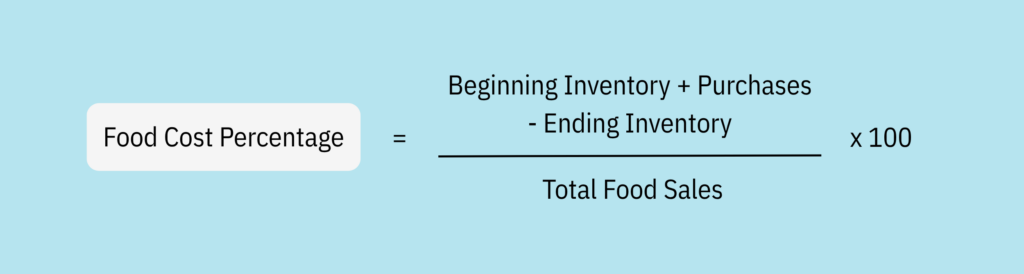
Food Cost ÷ Total Food Sales × 100 = Food Cost Percentage
Here’s what it means in simple terms:
- Food cost: The dollar amount you calculated using the standard formula (Beginning Inventory + Purchases − Ending Inventory).
- Food sales: The total revenue from food sold during the same period.
- Multiply the result by 100 to convert it into a percentage.
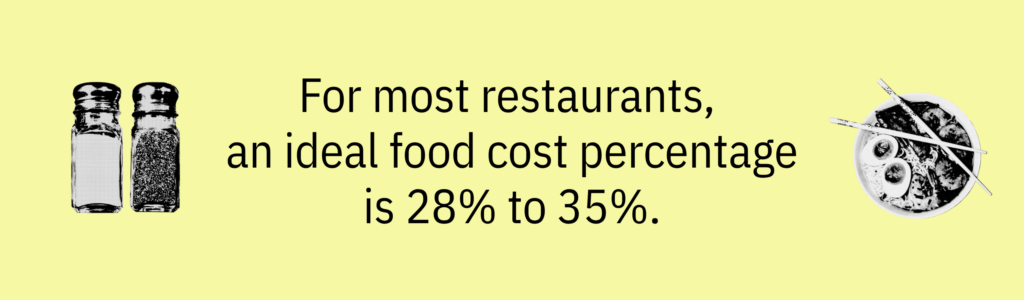
This shows how much of your food sales went directly to covering the cost of ingredients. Most restaurants aim for an ideal food cost percentage between 28%-35%, depending on the concept, menu style, and pricing strategy.
If your number is higher than that range, you could be dealing with issues like inflated ingredient costs, inconsistent portion sizes, or poor inventory management.
Lower than that, and it’s worth asking if you’re underpricing or compromising on quality.
Walk Through of a Realistic Food Cost Percentage Example
Let’s go back to the example from the previous section. We calculated a total restaurant food cost of $13,000 for October. Let’s say your total food sales for the same period were $40,000.
Now plug those numbers into the food cost percentage formula:
$13,000 ÷ $40,000 × 100 = 32.5%
Your food cost percentage is 32.5%—right in the typical range for many restaurants.
Now you’ve got a clear metric that you can track week over week or month over month.
What Your Food Cost Percentage Tells You
Your restaurant’s food cost percentage is more than just a number—it’s your performance indicator.
- If it’s consistently high, you’re bleeding money somewhere.
- If it’s dropping, it could be a sign that you’re under-portioning or downgrading quality ingredients.
- If it’s steady and within your target food cost percentage, that means your systems are working.
But remember: food cost is just one piece of the puzzle. It’s powerful, but it doesn’t tell the whole story.
Use it alongside metrics like labor cost, prime cost, and menu item popularity to get a full picture of your restaurant business’s health.
If you want to skip the manual work, try our free Food Cost Calculator below. It lets you plug in your beginning inventory, purchases, and ending inventory to instantly see your food cost percentage.
Key Factors That Influence Your Food Cost
Your food cost percentage is shaped by dozens of daily decisions, some that happen in your kitchen, and others that come from way up the supply chain.
Let’s break down the most common factors that influence your numbers.
Ingredient Prices and Vendor Relationships Matter More Than You Think
The cost of your ingredients is often the biggest driver of your food cost. Prices fluctuate based on seasonality, supply chain issues, and even weather.
Building strong relationships with your vendors gives you more leverage to negotiate pricing, ask about substitutions, and learn when market shifts are coming.
Smart operators review invoices regularly, compare suppliers when necessary, and use seasonal ingredients when possible to keep costs steady without compromising quality.
Your Menu, Portions, and Team’s Execution Might Be Driving Costs Up

What you sell—and how often you sell it—has a major impact on your food cost.
For example, if guests gravitate toward dishes with higher ingredient costs, your overall percentage will rise even if your recipes are costed correctly. If your team is pushing the wrong dishes or your best-sellers are your least profitable, your food cost will reflect that.
Portion control is another huge variable. If your cooks are eyeballing servings, not using scales, proper ladles, or pre-portioned items, these small overages add up when you’re executing high volume.
A perfectly costed recipe means nothing if your team isn’t following it as closely as possible.
Food Waste and Theft Are Silent Profit Killers
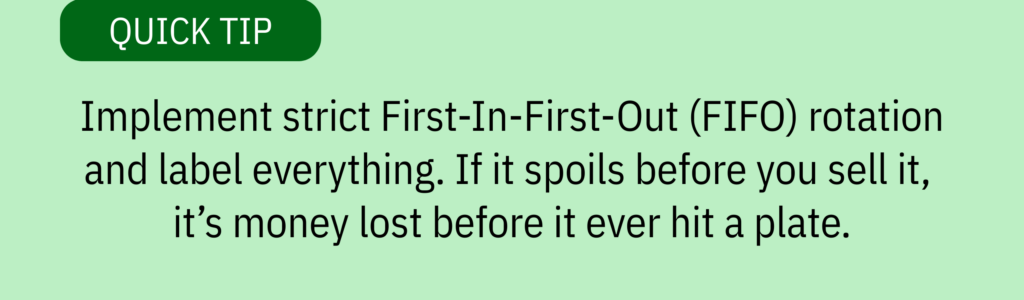
This is the part of food cost that’s easiest to ignore—and the most dangerous to your profits. When food gets thrown out, goes bad, or mysteriously disappears, that’s money lost before it ever hits a plate.
Some of this is about systems:
- Poor labeling
- Disorganized storage
- Lack of rotation (Not using FIFO: First In First Out)
- Prep not matching demand
And some of it is kitchen culture: if your team isn’t trained to respect and treat food like money, they won’t.
“Off-the-books” food, whether that’s unauthorized staff meals, comped items that aren’t tracked, or straight-up theft, can quietly eat away at your margins if you’re not keeping an eye on it.
Strategies To Control and Lower Your Food Cost

Once you understand what drives your food cost, the next step is tightening control over it. The goal isn’t to cut corners; it’s to run your kitchen more intentionally.
With a few focused strategies, you can protect your margins while maintaining the quality and consistency your guests expect.
Purchasing Strategies: Negotiate Smart, Buy Intentionally, and Lean Into Seasonality
Your purchasing habits have a huge impact on your food cost, so don’t approach the task passively.
Strong vendor relationships give you leverage when prices fluctuate, so review contracts regularly, compare quotes, and negotiate where appropriate—especially on high-volume items.
Buying in bulk can also reduce your cost per unit, but only if you have the storage space and turnover to prevent waste.
Seasonal ingredient switching is another powerful tool; produce and proteins that are in season are not only more affordable but often higher quality, making it easier to maintain both consistency and profit.
Portion Control: Train Your Team and Standardize Everything
Even perfectly negotiated pricing can’t offset inconsistent portioning.
When staff members eyeball ingredients or deviate from your specs, your food cost rises without any increase in revenue.
Standardized recipes, clear portion guides, and consistent training help ensure every dish leaving the kitchen matches your cost targets. Tools like scales, portion scoops and ladles, and pre-portioned prep work make it even easier for teams to follow guidelines, especially during busy shifts.

Cut the Waste: Get Ruthless With Storage and Prep Systems
Waste is one of the biggest and most preventable contributors to high food costs.
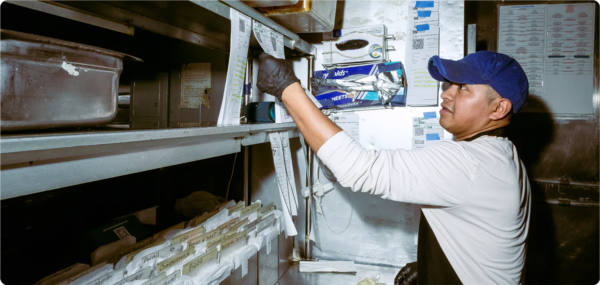
Proper storage practices, like labeling, dating, and keeping your walk-in organized, reduce spoilage and make it easier to track what you actually have on hand.
Smart prep systems help your team avoid overproduction, while tighter forecasting keeps you from ordering more than you need.
Strong inventory habits, such as rotating stock, counting regularly, and reviewing discrepancies, give you visibility into where product is being lost so you can address issues before they become expensive patterns.
These strategies take time to build, but once they’re in place, they create a more efficient kitchen, reduce unnecessary spending, and help you maintain a healthier food cost long term.
The Best Way To Use Food Cost To Price Your Menu
Once you’ve established your food cost percentage, you can start using it to make smarter menu pricing decisions. Your goal isn’t just to cover ingredient costs—it’s to balance profitability, guest expectations, and the overall financial health of your restaurant.
Use Food Cost Percentage as a Starting Point—Not a Final Answer
Most restaurants use food cost percentage to set menu prices. And that’s a smart place to begin. If you know your target food cost percentage is 30%, and a dish costs $5 to produce, the math says you should charge around $16.67.
But here’s the catch: food cost percentage doesn’t tell you the full story. It doesn’t factor in labor, rent, or the value guests place on the item.
Some dishes can carry a higher food cost because they’re popular or drive traffic. Others may have low food costs but take too much time on the line.
In other words, it’s a helpful metric—but not the only one you should rely on.
Think in Contribution Margin, Not Just Percentages
Instead of asking “what’s the food cost percentage on this dish?”, ask: “how many dollars does this dish contribute to covering my other costs and profit?”
That’s the contribution margin—the difference between what you charge and what the dish costs to make.
A burger that costs $4 to make and sells for $12 has a margin of $8, even if its food cost percentage is a bit high. That might still be a win, especially if it’s a volume driver.
By thinking in dollars instead of just percentages, you can make smarter decisions about what belongs on your menu and where to focus your energy.
Balance Profitability With Guest Value Perception
Your guests don’t care about your food cost—they care about whether what they’re paying feels fair for what they’re getting. That’s why pricing can’t just be an exercise in math. You have to look at your menu through the lens of perceived value.
- Are there high-cost menu items that customers might be willing to pay more to get?
- Are there low-cost items that you could apply a higher price tag because of presentation, plating, or experience?
Menu pricing is part psychology, part strategy. If you can align what your dishes cost, what they contribute, and how they’re perceived, you’ll end up with a menu that’s both profitable and competitive.
Tools and Systems That Make Food Cost Management Easier

Yes, you can manage inventory and calculate your food costs manually, but the right tools will make the process faster, more accurate, and far easier to maintain week after week. These systems help you stay proactive instead of reacting after problems show up on your P&L.
Inventory Management Tools That Do the Heavy Lifting
Manually counting inventory is tedious, time-consuming, and prone to errors. Modern inventory tools automate large parts of the process by storing unit costs, tracking quantities, and calculating usage in real time.
Many systems integrate with your POS system to let you scan items, sync invoices, and generate instant reports so you always know what you have, what you used, and what you need to reorder.
This level of accuracy makes your food cost calculations more reliable and helps you spot patterns like over-ordering or unexpected shrinkage.
POS Insights That Reveal What’s Really Driving Profit
When you connect your food cost data with sales data from your POS, you can see exactly which menu items are profitable, which are underperforming, and where small changes could make a big impact.
You’ll gain clarity on things like:
- High-volume, low-margin items that may be hurting your bottom line
- Sleeper hits that deserve more visibility or a higher price
- How modifiers and substitutions affect profitability
All of this insight helps you make informed pricing and menu-engineering decisions based on real data, not what you think “feels right.”
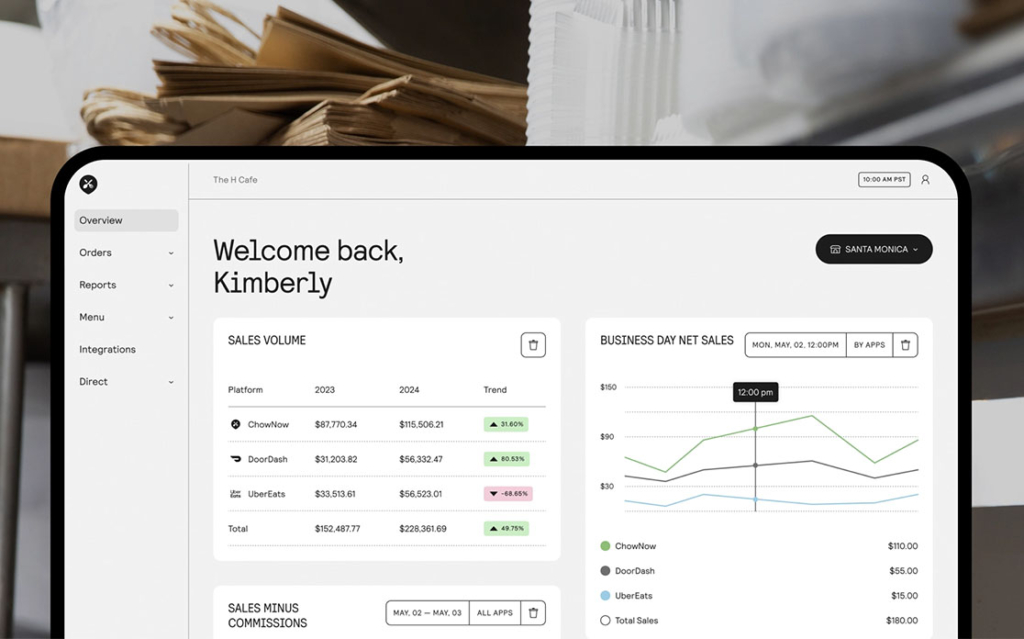
Reporting Workflows That Keep You Ahead of the Curve
The real power of technology is that it lets you monitor food cost trends over time—not just in isolated snapshots. Consistent reporting helps you notice issues before they become problems.
Whether it’s a dashboard that updates daily or a weekly email summary of key metrics, the goal is simple: keep food cost visible, not buried in spreadsheets.
When you’re looking at the right numbers regularly, you can adjust faster and run your restaurant with confidence.
Common Mistakes Operators Make With Food Cost
Even the most experienced restaurant owners can fall into traps when it comes to food cost. Most of these mistakes don’t happen all at once, but instead happen slowly over time, quietly chipping away at your margins.
Recognizing the signs easily can save you thousands. Here are the most common missteps that drive food costs higher than they need to be.
Not Tracking Inventory Consistently or Accurately
You can’t control what you don’t measure, and inaccurate inventory counts are the fastest way to throw off your food cost calculations.
Some restaurants don’t count inventory on a tight schedule. Others rush through the process, relying on estimates instead of actual weights, counts, and values. Either way, you end up with bad info going into your food cost formula, which means every decision you make is based on flawed data.
To fix it, you have to standardize the process. Count inventory on an unchanging schedule, use consistent units, and train your team to take it seriously.
Ignoring Small Variances That Snowball Into Major Cost Issues
A few missing cases here, some over-portioning there—it might not feel like much week to week. But over time, these small variances create massive leakage.
If you’re not comparing your theoretical food cost to your actual food cost regularly, you won’t catch these issues until they’ve already done serious damage. The longer you go without noticing, the harder it becomes to pinpoint the cause.
It’s not about being perfect—it’s about being proactive and diligent. Small fixes made early can prevent big problems down the line.
Overreacting to Symptoms Instead of Solving Root Issues
It’s tempting to make quick adjustments when food costs spike—raise prices, reduce portions, cut ingredients. But if you’re only treating symptoms, you’re missing the bigger picture.
Maybe the issue isn’t ingredient cost—it’s waste.
Maybe it’s not the menu—it’s execution.
Without digging into the data or talking to your team, it’s easy to jump to conclusions that don’t actually solve the problem.
Instead, step back. Look at the full context before you make changes. That’s how you solve the real issue, rather than creating new ones.
Mastering Food Cost Is How Great Restaurants Stay Profitable
Mastering food cost isn’t just about cutting expenses—it’s about running a smarter, more sustainable operation. The restaurants that succeed long-term are the ones that use their numbers to make better decisions every single day.
Contact ChowNow to learn you can price your menu on your Direct Online Ordering to ensure you’re keeping more profit.
Restaurant Food Cost Frequently Asked Questions
What is a good food cost percentage for most restaurants?
For most restaurants, a good food cost percentage typically falls between 28%-35%, depending on your concept and service style. Quick-service restaurants often stay on the lower end because of standardized recipes and higher volume, while fine dining may run higher due to premium ingredients.
The key is to track your food cost percentage over time, compare it to your own historical data, and make pricing or purchasing adjustments when it starts to creep above your ideal range.
How often should I calculate my food cost?
You should calculate your food cost at least once a month, but many successful operators track it weekly for better visibility and faster decision-making. More frequent tracking helps you spot issues early, adjust purchasing, reduce waste, and respond to cost fluctuations before they impact your bottom line.
What’s the difference between food cost and prime cost?
Food cost refers specifically to the cost of ingredients used to produce your menu items. Prime cost is a broader metric that combines your food cost and labor cost—together they typically make up the largest portion of your operating expenses. Monitoring both is critical for keeping your restaurant profitable and financially healthy.
How do rising ingredient prices affect food cost?
Rising ingredient prices increase your overall food cost, which in turn raises your food cost percentage unless you adjust pricing, portions, or purchasing habits. To stay ahead, operators need to monitor cost changes closely and make strategic updates to menus and vendor agreements when prices shift.
Should I ever raise prices based on food cost changes?
Yes, raising menu prices is sometimes necessary when food costs rise significantly, but it should be done carefully and strategically. Before increasing prices, consider whether you can adjust portion sizes, substitute ingredients, or spotlight more profitable menu items. If you do raise prices, clearly communicate value through quality, presentation, or guest experience.